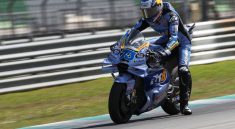
The Thailand Grand Prix was marked by an unexpected situation for several MotoGP riders, where the equipment meant to ensure their safety became a source of stress. The late homologation of helmets revealed flaws in team preparations, highlighting the challenges posed by the recent FIM regulations.

A Season Already Under Pressure
The start of each MotoGP season is traditionally accompanied by a certain degree of uncertainty, but the Thailand GP added an extra layer of complexity. Riders, already facing the pressures of competition, had to contend with unexpected equipment issues. Among them, Pecco Bagnaia, Enea Bastianini, and Diogo Moreira experienced a rather chaotic situation, where the helmet, a symbol of safety, turned into a logistical headache.
A Complex Regulation at the Root of the Complications
This delicate situation stems from the new helmet homologation imposed by the Fédération Internationale de Motocyclisme (FIM): the FIMFRHPhe-02 standard. Announced three years ago, this regulation aims to enhance rider safety, but it has also placed manufacturers in a precarious position. Stricter impact tests and requirements to ensure visors do not detach in the event of a fall have led several brands to be unprepared for the start of the season. In short, riders found themselves in a situation where they had to juggle safety and performance.
The Logistical Headache of Homologations
The case of PT Tara Group, supplier of KYT and Suomy helmets, perfectly illustrates this situation. The specific sizes for Bastianini and Moreira received their homologation only late, forcing the riders to use alternative helmets during the early sessions. This raises a crucial question: how could such a situation occur? The answer lies in the fact that certified labels must be printed in Switzerland, creating a real obstacle course to retrieve these precious documents. An employee had to make an urgent trip to Mies, Switzerland, before taking a flight to Thailand, a mission complicated by airspace closures due to geopolitical tensions.
Improvised Solutions on the Circuit
Faced with this uncertainty, the riders had no choice but to improvise. With helmets from competing brands at their disposal, Bastianini started the weekend with an Arai model, which he was not entirely comfortable with. This lack of comfort prompted the rider to switch to an Alpinestars helmet, a brand with which Bagnaia is already associated as an ambassador. This situation highlights the pressure riders are under to perform, even when conditions are less than ideal. Nevertheless, this improvisation raises questions about the uniformity of equipment and the teams’ ability to manage unforeseen crises.
Back to Normal… Finally
Fortunately, the situation was resolved just in time for Sunday’s warm-up. The three riders were finally able to wear their usual helmets, now compliant with the new homologation standards. However, this happy outcome should not overshadow the lessons to be learned from this experience. Teams must anticipate these regulatory changes to avoid compromising rider safety or their performance on the track.
Impact on the Industry: Towards Better Preparation?
The repercussions of this misadventure extend far beyond a mere weekend incident. It raises fundamental questions about the preparedness of teams and suppliers in the face of new regulations. If brands must adapt to stricter safety standards, this also implies increased investment in research and development, as well as impeccable logistical planning. In the future, it will be crucial for MotoGP teams to ensure that all equipment meets standards before the start of each season to avoid such situations.
In Summary
- The Thailand GP revealed helmet homologation issues for several riders.
- The new FIM regulation has tested equipment manufacturers.
- Riders had to improvise with alternative helmets throughout the weekend.
- The quick resolution allowed a return to normal for Sunday’s warm-up.
- This situation underscores the importance of better logistical preparation in the industry.
Useful Conclusion: This misadventure at the Thailand GP illustrates the challenges faced by riders and teams in light of increasingly stringent regulations. For whom? For teams that must anticipate these changes. What alternatives? Better logistical preparation and enhanced dialogue with manufacturers. Strengths include the resilience of the riders, while the limitations lie in the unpreparedness for complex standards.