


Max Verstappen has hit hard this Thursday in Baréin, revealing a palpable discomfort behind the facade smiles. While teams are excited about the first engine designed in Milton Keynes, the defending champion expresses an unprecedented frustration with the driving of his RB22. An evolution that seems closer to Formula E than to the very essence of Formula 1.
Shocking statements at the heart of testing
During a press conference, Verstappen did not hesitate to share his feelings, and the least one can say is that he does not mince his words. “Driving is not very fun,” he said, with a frank look. For him, the Formula 1 season is not simply a performance chart, but an exciting driving experience. However, it is evident that the pleasure is absent.
He continues with a striking metaphor: “It’s not very ‘Formula 1’. It looks a bit like Formula E with steroids.” A bitter diagnosis that does not leave motorsport enthusiasts indifferent, especially since Verstappen acknowledges the hard work of the technical teams. But, let’s face it, technical performance must also go hand in hand with the sensations behind the wheel.
The weight of regulation on the driving experience
The double world champion emphasises that, despite his respect for the current rules, he believes that the energy aspect is taking too much prominence over the pleasure of driving. “A lot of things happen. Much of what you do as a driver has a huge effect on the energy aspect.” In other words, Verstappen laments a Formula 1 that is drifting away from its roots, giving way to an almost accounting management of performance.
This statement resonates like a bell: should energy management, although essential, really be at the centre of driving? For Verstappen, the answer is clear. “Maybe it’s better then to drive in Formula E, isn’t it?” A phrase that grinds teeth, but reveals a real dilemma for modern drivers.
A powerful car but not fun
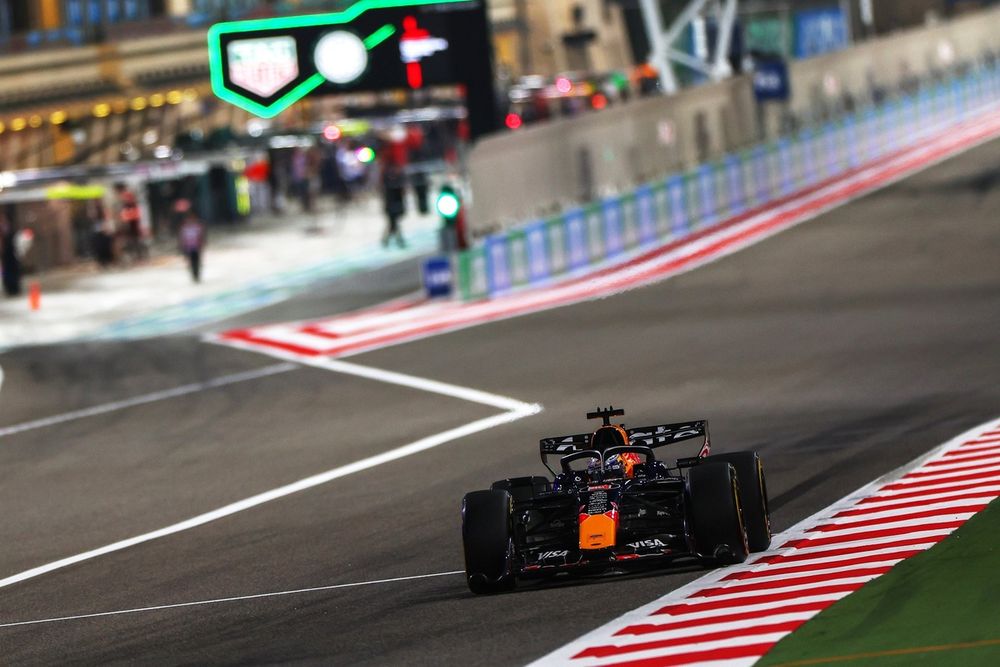
Max Verstappen at the Baréin tests.
Still, Verstappen commits to “always giving his all”, especially with the prevailing enthusiasm at Red Bull. However, he does not hesitate to make his points clear: “For me, a winning car is not enough. It also has to be fun to drive.” A heartfelt cry that says a lot about his desire for adrenaline, excitement, and challenge.
He points out that the beauty and proportions of the car are not the problem. “It’s just that everything else is, for me, a bit anti-racing.” These words resonate as a call to return to the roots of a discipline that has always been synonymous with speed and spectacle.
A paradigm shift in driving
The Dutch champion also mentions the evolution of driving in Formula 1, which seems to be heading towards a less instinctive and more strategic approach. “The fastest drivers or the best usually end up winning the championship or finding themselves in the best team,” he observes. However, he emphasises that good drivers will know how to adapt to these changes.
But, shouldn’t this adaptation be made without sacrificing the authenticity of driving? Verstappen seems convinced that the overall driving experience is in decline. “Simply, the way of racing is changing and I would say it’s less pure.” A diagnosis that could make authorities reflect on the direction the sport is taking.
In search of a new challenge
As the shadow of the current regulation looms over Formula 1 for several more seasons, Verstappen does not hesitate to mention other horizons. “I am also exploring other things outside of Formula 1 to have fun.” This desire to explore other categories, such as GT and endurance, could mark a turning point in his career.
Max Verstappen thus establishes himself as a driver in search of a driving experience that excites him, where speed does not only rhyme with energy management. It is not simply a cry of despair, but an invitation to rethink Formula 1 in a world where spectacle must remain at the heart of concerns.


