Munich. The BMW Museum has celebrated a record-breaking attendance of over 847,000 visitors in 2025, kicking off the new year with a dedicated exhibition for the iconic BMW 6 Series, marking its 50th anniversary. Since its debut in spring 1976, the 6 Series has evolved into a design classic, with the original model boasting the longest production run of any BMW series at 13 years. This new exhibition runs until January 2027 and showcases the evolution of the “sharknose” design alongside a display of various models.
A Legacy of Elegance and Performance
BMW is commemorating five decades of the 6 Series through a curated selection of exhibits. Launched in the mid-1970s, the original model redefined automotive construction standards. Helmut Käs, Head of BMW Group Classic and BMW Museum, remarked, “For five decades now, the BMW 6 Series has been a paragon of elegance, sporting potency and long-distance comfort.” This design has cemented its place as one of BMW’s most influential models, cherished by enthusiasts globally.
The Original Model: A Coupé Icon
Produced from 1976 to 1989 exclusively as a coupé, the initial 6 Series drew technical inspiration from the BMW 5 Series while adopting styling cues from luxurious coupés of the previous decade. Initially built by Karmann and later at BMW Plant Dingolfing starting in 1982, it featured five engine variants, including a US-specific model. Chief designer Paul Bracq’s vision resulted in its distinctive “sharknose” front and striking profile. Following its discontinuation, the 8 Series took over in 1989 until the new generation of the 6 Series (E63) launched in 2003.
Success on Track and Screen
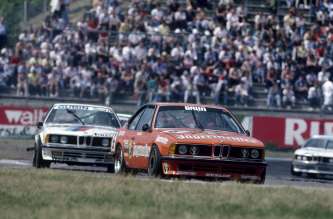
The BMW 6 Series made a notable impact in motorsport with the introduction of the 635CSi in Group A touring car racing. It clinched victories in both the European Touring Car Championship (1984 and 1986) and the German Production Car Championship (1984). Beyond racing, its allure extended to cinema, featuring prominently in productions like Dallas and Back to the Future II. The museum’s special exhibition highlights this cinematic legacy alongside a floating model inspired by French photographer Sylvain Viau’s “Flying Cars” series.
Cinematic Icons: The M635CSi and 628CSi
The BMW M635CSi (1985) and BMW 628CSi (1982) are showcased against a vintage film set backdrop. The M635CSi, boasting an engine derived from the M1 producing 286 hp and achieving speeds above 250 km/h (155 mph), was celebrated as one of the fastest four-seaters during its time. Conversely, the 628CSi was well-received for its blend of performance and comfort, featuring a state-of-the-art fuel-injected engine that replaced its carburettor predecessor.
Artistic Contributions to Culture
The exhibition also underscores the cultural significance of the BMW 6 Series through its Art Car Gallery. Two examples of the BMW 635CSi from the Art Car Collection are displayed, including works by Ernst Fuchs and Robert Rauschenberg. Fuchs’ “Firefox on Harehunt” pays homage to mythology and speed, while Rauschenberg transformed his version into a black-and-white collage representing art history and culture.
Technical Innovations Over Time
Another prominent model on display is the BMW 633CSi, which debuted alongside the 630CS. Initially equipped with Bosch’s L-Jetronic fuel injection system, it later adopted DME digital electronics for improved emissions and efficiency. However, this update resulted in a slight decrease in power output from 200 hp to 197 hp.
Exhibition Details
The current exhibitions at the BMW Museum include:
- BMW 6 Series body-only model outside the museum
- BMW 628CSi (1982) in the Rotunda
- BMW M635CSi (1985) in the Rotunda
- BMW 633CSi (1976) in the “car tower”
- BMW Art Car #5 by Ernst Fuchs (1982) in Art Car Gallery (until July 2026)
- BMW Art Car #6 by Robert Rauschenberg (1986) in Art Car Gallery (until end of 2026)
The exhibitions will continue until late 2026, offering visitors insights into both automotive history and cultural influence.



© BMW Group