With over 125,200 stolen vehicles in 2025, France retains its unenviable title of the champion of car thefts in Europe. A vehicle disappears every four minutes, criminal networks are organising and professionalising, making the situation alarming for motorists and insurers. In the face of this scourge, what can be done to protect one’s property?
125,200 thefts in 2025: France remains the champion of Europe
France retains its sad status as the most affected country by vehicle thefts in Europe. In 2025, the Ministry of the Interior recorded 125,200 incidents, which means a stolen vehicle every four minutes. This alarming figure places France ahead of Italy and the United Kingdom, which is suffering from an intensification of electronic methods (94% of cases), leaving traditional anti-theft devices on the sidelines like relics of another time.
Every year since 2018, Coyote Secure has been analysing the evolution of this crime through its Theft Observatory, relying on the experience of 500,000 equipped vehicles. Although the overall volume of thefts remains relatively stable compared to 2024, methods and networks are evolving. There are fewer direct exports outside the Schengen area (30% of international operations) and a rise in the ‘makeover’ of vehicles, which now represents 40% of cases.
Electronic thefts, targeted SUVs, cross-border networks: automotive crime is exploding in France and costing more and more. © Coyote
International makeovers: the new trick of thieves
Criminal networks have adapted to increased surveillance. Exporting to the Maghreb is no longer the norm. Stolen vehicles are now transported to clandestine workshops, where they undergo a complete makeover: changing the VIN number, neutralising engravings and serial numbers. The objective is clear: to reintegrate these vehicles into the European market as if they were perfectly legal, particularly in France, where the second-hand market is stagnating while new car sales are down by 5% in 2025.
A direct consequence of this evolution is that international recoveries carried out by Coyote Secure have increased by 51.8% in one year. These operations are mainly concentrated in border areas: Belgium (50%), Germany (20%), Spain (10%) and the Netherlands (5%). Once stolen, a vehicle is generally transferred to a clandestine garage within a few hours. Without a proactive tracking device, any recovery attempt then becomes almost illusory.
More and more stolen vehicles are now being made over to be resold in the European area ‘legally’. © Coyote
Seizures on the rise: open-air criminal platforms
Coyote Secure is increasingly uncovering real “gas factories” during its interventions. In 2025, incidental seizures, meaning the accidental discovery of additional vehicles on the same site, increased by 18.6%. These discoveries reveal heavy logistical structures, often linked to drug trafficking. Paradoxically, the large anti-drug operations carried out in 2025 have increased police pressure, but also the vigilance of theft networks, which are reorganising to circumvent controls.
An exploding bill
The average cost of a claim related to a theft has more than doubled in ten years, with an increase of 138% according to France Assureurs. This cost is now twice that of a classic material accident. Between the rising prices of new vehicles, the impact of the ecological penalty, and increasingly stringent regulations, the annual bill approaches 600 million euros. This cost is directly passed on to policyholders, who must face an average premium increase of 5% expected in 2026.
A study conducted by ViaVoice in October 2025 also reveals a massive lack of knowledge regarding guarantees: 66% of motorists are unaware of their reimbursement conditions in the event of theft. Even more concerning, eight out of ten do not know that the ecological penalty is non-recoverable, which can represent several thousand euros to pay for the purchase of a new replacement vehicle.
A crime now digital, targeted and geographically structured
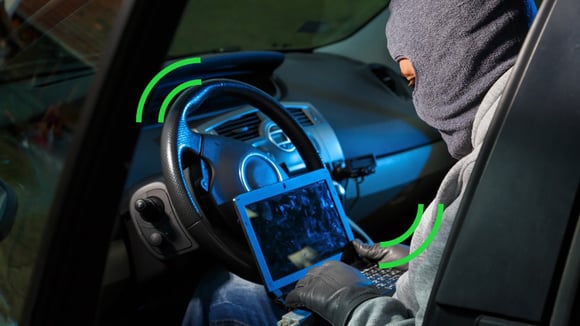
Today, car theft in France is primarily a digital phenomenon. According to Coyote Secure, 94% of thefts now exploit electronic vulnerabilities, whether through mouse-jacking via key relays, hacking the OBD port, or remote attacks. These quick and invisible methods render most original protections, such as built-in alarms, obsolete. Paradoxically, it is the most recent and connected vehicles that are also the most vulnerable.
This sophistication partly explains the strong geographical concentration of thefts. Île-de-France alone accounts for 50% of the cases recorded by Coyote Secure, thanks to its automotive density and its role as a logistical hub. The North follows with 20%, while the Grand Est shows a 20% increase year-on-year, linked to its immediate proximity to Belgium and Germany.

© Coyote
SUVs and hybrids: priority targets
The choices of thieves are not random. SUVs overwhelmingly dominate the statistics, representing 70% of thefts, a figure that corresponds to their weight in the French automotive market. Hybrid vehicles are also experiencing a spectacular surge: they now account for 53% of recorded thefts, with an estimated risk of 3.1‰. Light commercial vehicles follow the same trend, reaching 11% of incidents, a direct reflection of their usage and resale value.
Another notable phenomenon is the explosion of thefts of motorhomes and vans, up by 30%. Their high value, ranging from 60,000 to 120,000 euros, makes them ideal targets for organised networks. Conversely, 100% electric vehicles have a very different profile: their recovery rate reaches 100%, as their limited range makes rapid exports abroad very difficult.
In case of theft: a race against time
In this context, time is a determining factor. The 9% of vehicles not recovered can mainly be explained by rapid dismantling, detection of the tracker by thieves, or even arson. Beyond 48 hours, the probability of recovery drops by 90%, making exportation almost inevitable.
Coyote Secure bases its strategy on this critical window. Since 2018, it has relied on a combination of technology and human intervention: a Nano 2.0 tracker with a five-year battery life and nine embedded technologies (GNSS, LTE-M, Sigfox, Wi-Fi, anti-jamming, confinement detection…), coupled with a team of operational detectives available 24/7. In 2025, this system boasts 91% recoveries in under 48 hours, with 93% of vehicles found intact.
With around twenty partnerships with insurers, Coyote Secure aims for an 80% reduction in theft-related claims. One challenge remains: awareness. Only a third of motorists are currently equipped, while two-thirds are still unaware of the true extent of their guarantees.