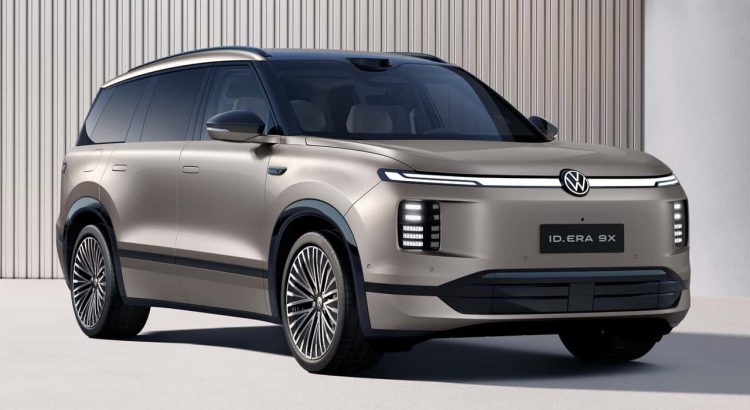
With the ID. Era 9X, Volkswagen is making a significant leap in electrifying its offering. This massive SUV, longer than an Audi Q7, embodies a new design language that promises to turn heads, even in the world of large SUVs. Get ready to discover a vehicle that combines power, technology, and a certain German elegance.
A giant on wheels
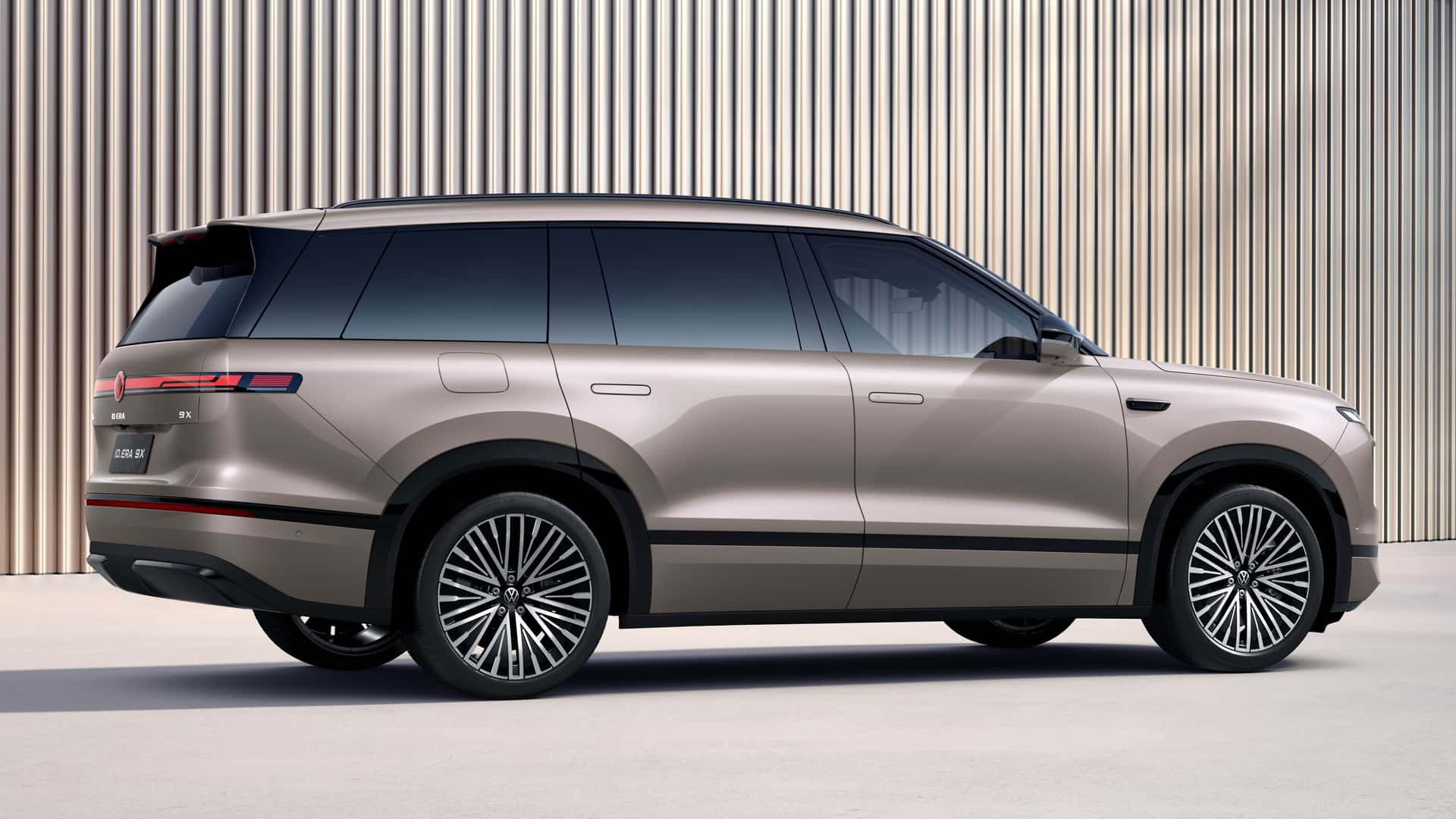
The puzzle of electrification at Volkswagen is finally taking shape with the arrival of its first electric vehicle featuring a thermal engine serving as a range extender. The ID. Era 9X, stemming from the VW-SAIC joint venture, is a production-ready version of the ID. Era concept presented last year. This full-size SUV, with its six seats, does not do things by halves: it measures 5,207 mm in length, surpassing the second-generation Atlas, known as the Teramont Pro in China.
Impressive dimensions
With dimensions of 1,997 mm wide and 1,810 mm high, the ID. Era 9X rests on a colossal wheelbase of 3,070 mm. By comparison, it is longer than most large SUVs in the Volkswagen group, with the exception of the long-wheelbase Bentley Bentayga. Only the upcoming Audi Q9 could surpass it. However, this giant has a substantial weight, with the heaviest version tipping the scales at an impressive 2.7 tonnes.
An innovative powertrain
But the real innovation lies in its powertrain. Indeed, Volkswagen has opted for a 1.5-litre turbo petrol engine that serves solely as a generator to recharge the battery. This four-cylinder engine belongs to the EA211 family and employs the Miller cycle, with variable geometry turbocharger technology inspired by Porsche. With a power output of 141 hp, this engine works in synergy with one or two electric motors.
The base model is equipped with a rear-mounted electric motor delivering 295 hp. For performance enthusiasts, the dual-motor configuration with all-wheel drive boosts the total power to an impressive 510 hp. Customers can choose between a 51.1 kWh battery for the base model and a larger 65.2 kWh option for those seeking more range.
Promising range
Volkswagen claims that its enhanced battery can offer over 400 kilometres of range according to the CLTC cycle, an enticing figure for urban drivers. Although the total range has not been officially disclosed, it is expected to exceed 965 kilometres thanks to the capacity of the petrol tank. One could say that range anxiety may well become a distant memory for future owners.
While the ID. Era 9X is unlikely to be marketed outside of China, rumours suggest that Volkswagen is considering launching range-extended electric vehicles in Europe and the United States. These initiatives could redefine the current automotive landscape.
A new direction for Volkswagen
Alongside this announcement, Volkswagen is preparing to launch its new sub-brand Scout, which will include the pickup Terra and the SUV Traveler. These models will also be equipped with a naturally aspirated petrol engine serving as a generator. With the Harvester option, they are expected to offer an impressive total range of 805 kilometres, including 241 kilometres in pure electric mode.

A response to market expectations
Motor1’s opinion: It makes sense for Volkswagen to explore range-extended electric vehicles, especially in a Chinese market where this technology is gaining traction. By adding a petrol engine to recharge the battery, Volkswagen hopes to alleviate concerns related to the range of electric vehicles and convince more buyers to make the leap to these new technologies.
One can also hope that this technology finds its way into other markets. Range extenders present undeniable advantages: they allow for a range comparable to that of petrol vehicles without the burden of an oversized battery.
Finally, reports suggest that BMW is also considering reintroducing range extenders after having used this system on the i3. Like Volkswagen, the Bavarian brand is looking to equip its larger SUVs with a petrol engine serving exclusively as a generator, with no mechanical connection to the wheels.
With the ID. Era 9X, Volkswagen is laying a cornerstone in its electric future while keeping an eye on market realities and consumer expectations. All that remains is to wait for the public’s reaction to this promising innovation.