
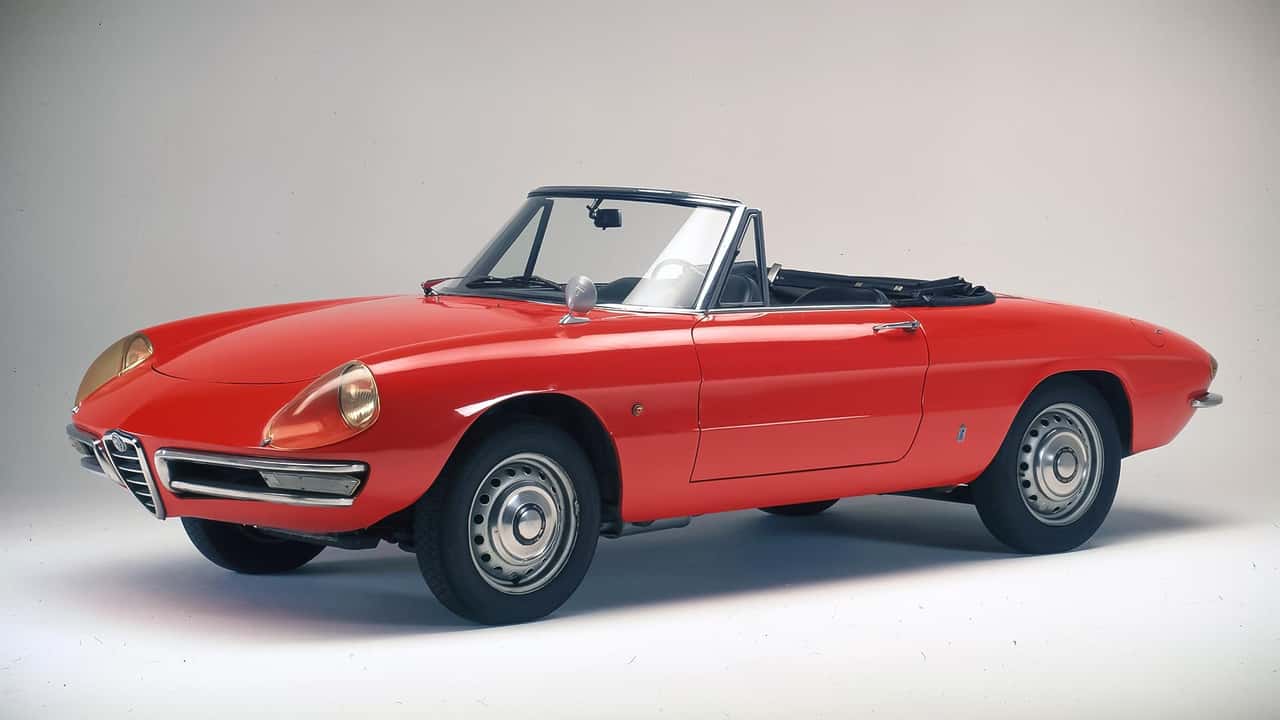
The first Alfa Romeo Spider was never a universal crowd-pleaser. That is precisely why it matters 60 years on: beneath a shape that split opinion, the Duetto defined a distinctly Italian idea of the roadster — less about broad consensus, more about elegance and engineering than its pretty image initially suggests.
In the automotive news cycle, anniversaries often serve as an excuse to dust off an old legend. Here, the more interesting point lies elsewhere. The original Spider did not become an icon because everyone loved it at first sight, but because Alfa Romeo was prepared to break with its own conventions.
The Spider filled an obvious gap in Alfa Romeo’s line-up
At the start of the 1960s, Alfa Romeo already had a strong foundation in the Giulia, a sharp-suited saloon with a lively character all of its own. The related coupés were moving the game on as well, yet there was still no open-top model capable of replacing the Giulietta Spider without dragging old styling themes along behind it.
So this was never merely a design exercise. It answered a genuine gap in the range and, just as importantly, a question of image. Alfa could not live on sensible, effective family cars alone: it needed a Spider that spoke to the heart as much as the hands on the wheel. That is where the Duetto story begins — with an ambition that sounded simple enough on paper, and was rather harder to deliver in steel.
Pininfarina pushed an aerodynamic shape at the risk of shocking buyers
Before the final car emerged, Alfa Romeo tried several directions. A detour via Bertone produced the Giugiaro-styled GTC in 1964, but the project went nowhere. The financial troubles at Touring, which had been due to build the car, also forced Alfa to rethink matters. The programme then returned to Pininfarina, drawing on styling research from the Superflow series that had been developed since the latter half of the 1950s.
What appeared in 1966 was anything but a compromise. With its very low nose, taut flanks, tapered tail and low waistline, the Spider 1600 looked first and foremost like an aerodynamic object rather than a pretty boulevard toy. Under Aldo Brovarone, with Battista “Pinin” Farina overseeing the wider vision, the car took on a smooth, almost liquid form. It had the flowing quality of a pebble worn down by the sea, and it wrong-footed those expecting a gentler descendant to the Giulietta Spider.
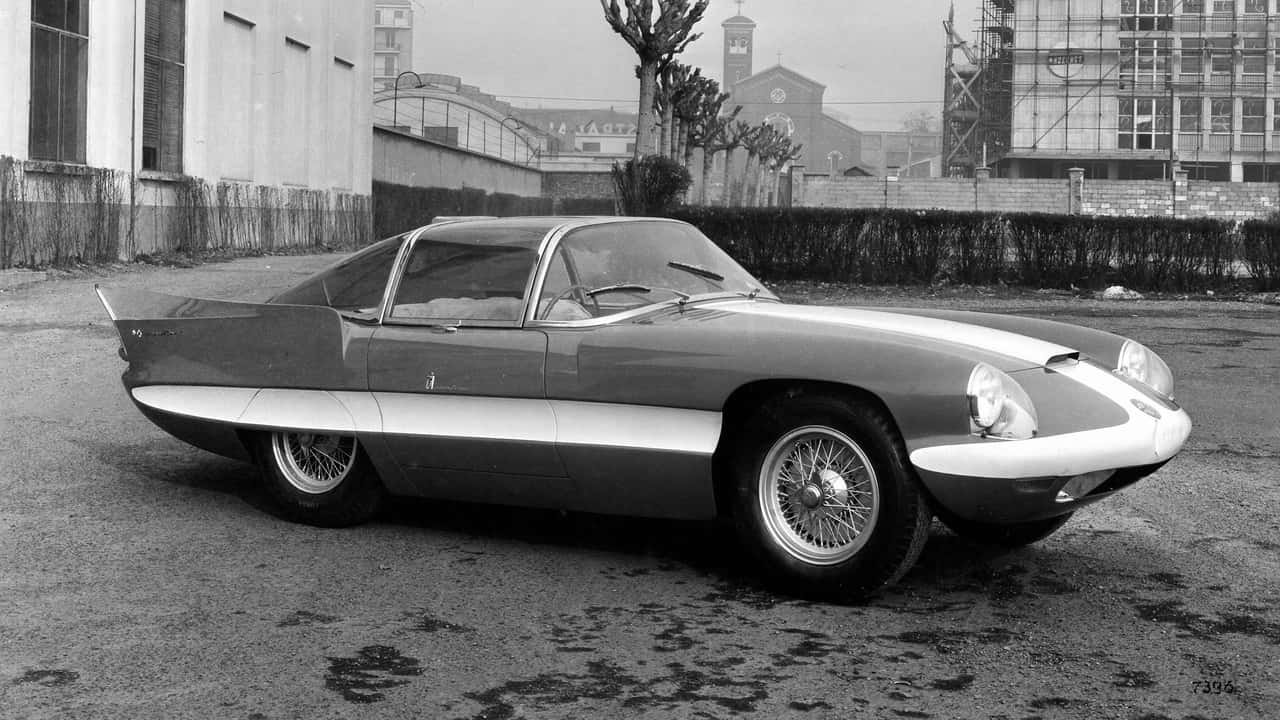
Super Flow 6C Pinin Farina (1957)

Alfa Romeo Super Flow III (1959) by Pininfarina

Alfa Romeo Spider Duetto (1966-1969)
That decision is central to the car’s status today. Alfa Romeo was not trying to reassure buyers; it was trying to move things on. Important cars are often born that way — by taking the risk of being disliked at launch.
The rounded tail caused muttering before becoming its signature
Buyers were introduced to a cabriolet measuring 4.25 m, powered by a 1.6 litre producing 80 kW (109 ch), but it was the body that drew all the attention. Underneath, the technical package was sound, drawing on the Giulia Sprint GT Veloce. The real dividing line was the so-called “Rundheck” rear end, that distinctive rounded and tapered tail which immediately split opinion.
Some Alfa loyalists found it too futuristic, too far removed from the firm’s established visual language. Others saw a rare purity in it, particularly with the hood folded, when the slim windscreen and small deflectors seemed almost to disappear. The pronounced side crease and plexiglass headlamp covers were not there simply for decoration either; they also reflected aerodynamic and structural thinking. In other words, the styling was doing a job rather than merely posing for one.
The nickname “Osso di Seppia”, used by workers in Grugliasco because of that tapering tail shape, neatly captures the car’s fate. What first looked like an oddity became its defining feature. Motoring history is full of that sort of revenge: the most debated lines often age better than the safer shapes that look old the day they leave the factory.

Alfa Romeo Spider Duetto (1966-1969)

Alfa Romeo Spider Duetto (1966-1969)
Its name wobbled, but its image soon took off
To support the launch, Alfa Romeo ran a competition to name its new Spider. More than 120,000 suggestions arrived in Arese. The chosen answer was “Duetto”, a name meant to express a harmony between grace and strength. A neat idea, save for the legal complications that quickly followed: an Italian confectioner claimed the trademark, while Volvo was already selling a model called Duett.
The badge was therefore officially dropped early in 1967. Even so, the name endured in the public memory. That is part of the Spider’s paradox: administratively weakened, yet culturally strengthened. The market and popular culture did the rest. Its Atlantic crossing aboard the liner Raffaello and the Spider’s appearance in The Graduate in 1967 gave it global visibility. Once a car lands in cinema at exactly the right moment, it stops being just a model and becomes part of the scenery in people’s minds.
The flattering comment attributed to Steve McQueen in 1966 belongs to the same story. There is no need to overstate it: by then, the Spider was already beginning to live beyond its specification sheet. For a roadster, that is usually where the real game starts.

Alfa Romeo Spider Duetto (1966-1969)
The Duetto’s real strength was a seriously credible technical base
If the Duetto has endured, it is not simply because of its looks. The Spider used the shortened chassis of the type 105 Giulia and arrived with a notably serious specification for its day: a 4-cylinder 1.6 litre engine, twin overhead camshafts, light-alloy block and cylinder head, twin twin-choke carburettors, a five-speed manual gearbox and disc brakes on all four wheels. In the mid-1960s, that was not a trivial detail. It was a statement of intent.
On the road, that set-up produced a roadster that did more than waft along in the sunshine. Alfa stuck to its philosophy: a Spider still had to feel like a proper sports car. Road testers of the time praised its behaviour, with the understandable caveat that wet roads could expose the limitations of the very narrow 155 tyres by modern standards. A top speed of 182 km/h underlined its performance, in an era when European traffic generally moved at a far more modest pace.
Inside, the atmosphere was simple but coherent. Two large dials sat ahead of the driver, the dashboard was painted in body colour, the materials were chosen with open-air use in mind, and the boot was more practical than one might expect. In use, the Duetto was no static showpiece. It had enough everyday usability to be driven properly, which helps separate it from some charming convertibles that soon become tiring to live with.

Alfa Romeo Spider Duetto (1966-1969)

Alfa Romeo Spider Duetto (1966-1969)
Engine changes quickly showed the pressures of success
The Spider sold well in Europe, but it was the American market that soon changed the picture. From 1968, the carburettor-fed 1600 no longer met tougher Californian emissions rules. Alfa Romeo therefore had to adapt its roadster without draining away its character. This was one of the model’s first real constraints: it was no longer enough merely to charm, it also had to comply.
The answer was the 1750 Veloce. Capacity rose to 1 779 cm³ and, for the United States, the engine gained Spica mechanical fuel injection. In Europe, carburettors remained. Output climbed to 113 ch, but the more noticeable gain came from improved torque and taller gearing, both of which made the car more relaxed to drive. Top speed rose to 188 km/h. It was not a revolution, and that is rather the point: it was a sensible piece of technical maturation.
Alfa also revised the chassis, the braking and a few presentation details. At the same time, it broadened the range downwards with the Spider 1300 Junior, offering 89 ch, fewer niceties and a considerably more accessible price of 10,990 marks, against 13,575 marks for the 1750 in Germany. That tells its own story about positioning: the more sophisticated and upmarket the Spider became, the more Alfa had to recreate an entry point for younger buyers.

Alfa Romeo Spider 1750 Veloce

Alfa Romeo Spider 1750 Veloce
At the end of 1969, the first major redesign brought the rounded-tail Spider to a close after around 13,600 examples. The new, more conventional rear end made the limit of the original concept plain enough: the styling boldness created the icon, but it was not the easiest solution to sustain in industrial terms.

Alfa Romeo Spider Duetto (1966-1969)
In summary
- The first Spider was created above all to fill a clear gap in the Alfa Romeo range.
- Its Pininfarina styling deliberately broke with the more traditional look of the Giulietta Spider.
- The rounded “Osso di Seppia” tail initially divided opinion before becoming the model’s most celebrated feature.
- The Duetto’s technical package was notably advanced for 1966, with twin cams, five speeds and four-wheel disc brakes.
- The arrival of the 1750 Veloce reflected both American regulations and the growing importance of export markets.
- The original Spider remained in this form only briefly, which only adds to its distinct place today.
Ultimately, the Duetto is not simply a beautiful old Alfa. It shows how a marque can build prestige by refusing to play it safe. For the classic-car enthusiast, it remains the Spider to choose if you want the purest expression of the model, complete with its strong styling, appealing engineering and period compromises. For easier ownership, later Spiders are the sensible alternatives, with rivals depending on your taste for charm or usability. But for sheer flair, the first one still stands apart.


