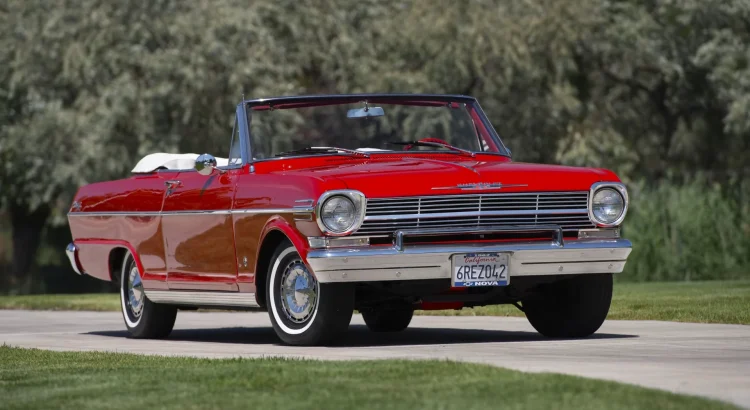
The 1962 Chevy II, a name that resonates in the hearts of American car enthusiasts, is often overshadowed by its more muscular cousin, the Camaro. However, behind its understated lines lies a true engineering feat, closer to the Ford Falcon than a racing beast. Get ready to discover this compact full of surprises that managed to establish itself in the small car market with an ingenious and pragmatic approach.
An Unexpected Little Brother
Before diving into the juicy details of the mechanics, let’s remember that many car enthusiasts primarily know the 1968 Nova and its subsequent models. The latter were popularised as sedan versions of the famous Camaro. But if we go back to 1962, the Chevy II, also known as the Nova, proves to be a thoughtful response to the challenges posed by the Ford Falcon, with its own strengths.
The Chevy II presents itself as a direct competitor to the Falcon with a length of 183 inches (464 cm), slightly larger than its rival which measures 181.1 inches (460 cm). But don’t be fooled by these numbers: despite its size, it was designed to appeal to the compact market with formidable efficiency. With a width of 70.8 inches (180 cm) compared to 70.6 inches (179 cm) for the Falcon, interior space was a significant criterion. One could say that Chevrolet bet on increased comfort without renouncing its origins.

The four-door version of the Chevy II Nova 400 looks elegant in its silver hue. With its classic curves and timeless design, it perfectly embodies the spirit of the 1960s.
Speaking of design, what about the engineering? Unlike the later Nova and Camaro, the Chevy II adopts an original front suspension where the coil springs and shock absorbers are mounted on a pivoting seat at the top of the upper arm. A feature shared with the Falcon that accentuates this lineage. It’s almost as if Ford decided to share its best friend with Chevrolet!
A Thoughtful Design
While the Chevy II was slightly larger than the Falcon, it was still built using conventional methods. A strategic choice that met the expectations of compact car buyers seeking simplicity and efficiency. Although Chevrolet wanted to innovate, they managed to respect the codes by offering features more familiar to consumers.
The comparative dimensions reveal that the base of the Chevy II was structured to be solid while remaining lightweight. For example, the wheelbase was 110 inches (279 cm) for the Chevy II, compared to 109.5 inches (278 cm) for the Falcon. This slight adjustment gives the impression that the car is more stable on the road, like a dancer well anchored on her toes.

A page from the 1962 brochure highlights the “quality features” of the Chevy II, showcasing its classic appeal with a modern touch. Every detail is designed to entice.
Of course, the rear suspension also deserves mention. The Chevy II stands out with its Mono-Plate rear springs that have only one leaf per side. A bold technology at the time, designed to reduce weight and improve ride comfort while maintaining efficiency. It’s reminiscent of a delicate recipe where each ingredient must be perfectly measured to create a tasty dish.

The Chevy II Nova 400 in all its glory. Its rounded silhouette and meticulous finishes testify to an era when every detail mattered.
Engines and Performance
Initially, the Chevy II offered two engines: a four-cylinder and a six-cylinder. The four-cylinder engine often made purists cringe as it tended to vibrate more than its six-cylinder counterparts. A configuration that led some users to turn to more powerful models for a smooth and enjoyable driving experience.
Speaking of power, the addition of the V8 Turbo-Fire 283 quickly allowed Chevrolet to gain popularity among thrill-seekers. This engine added less than 150 lb (68 kg) to the car’s total weight, a remarkable feat considering the technical demands. The balance between performance and consumption was carefully studied. It’s like finding the perfect balance in a musical composition: each note must find its place without throwing off the whole.
Driving: A Pleasure to Discover
Behind the wheel of the Chevy II, one quickly feels that this is a car made for the road. With its well-positioned engine and balanced chassis, driving becomes an enjoyable experience, even on winding roads. One could say it is a true travel companion for those who love to cover miles without fatigue.
One of its main strengths lies in its suspension system that offers appreciable comfort. The mono-leaf springs allow for a smooth ride that recalls a yacht gliding peacefully on calm waters. However, don’t expect lightning agility like that of a sports car; it’s more of a tranquil pleasure on paved roads than a frantic race on a track.

The front suspension of the Chevy II is designed to optimise handling while providing unmatched comfort. Its well-thought-out architecture makes all the difference on the road.
Conclusion: An Iconic Car
While the Chevy II may seem lightweight compared to more iconic models like the Camaro or even the Mustang, it has managed to forge its own identity. By selling over 326,607 units in 1962 and even reaching 372,626 in 1963, it proved that it could attract an audience seeking practicality without sacrificing elegance.
In summary, the Chevy II is a beautiful demonstration that sometimes, it is not the roar of a V8 engine that creates all the magic of a car, but rather its story and its footprint on the American road.
Official Sources: