While the 60s and 70s are often synonymous with roaring V8s, six-cylinder engines managed to hold their own with surprising performance. In this golden age of muscle cars, some six-cylinder models defied expectations, proving they could compete with, and even surpass, many V8s. Let’s discover together these overlooked gems that marked their era.
A retrospective look at the six-cylinder engine
In the automotive landscape of the 60s, the six-cylinder engine had a mixed reputation. Often regarded as the choice of economical drivers, it was frequently overshadowed by the power of V8s. However, upon closer inspection, some of these six cylinders turned out to be true rockets on wheels, capable of competing with their more powerful counterparts.
The reputation of the six-cylinder was built on several intrinsic qualities. Its balanced design makes it a smoother engine than the four-cylinder, contributing to its popularity. Iconic models like the Chevrolet Stovebolt and the Plymouth Slant Six marked this era with performances that often surprised skeptics.
The exceptions that prove the rule
The 50s and 60s saw the emergence of six-cylinder models that defied expectations. Take, for example, the Hudson Hornet (1953-1955), equipped with a flat six-cylinder engine of 308 cubic inches, which offered a power of 170 horsepower. With a 0 to 60 mph performance in just 12.2 seconds, it even found its place in the world of NASCAR racing.
Similarly, the Willys Aero, which was produced in small quantities, featured a six-cylinder engine offering 115 horsepower, allowing for respectable performance for its time. These models proved that the six-cylinder was not just an economical alternative, but could also be synonymous with driving pleasure.
The quest for the fastest
So, what is the best six-cylinder of the 60s and 70s? To find out, we compiled the results of the fastest road tests. Here are a few that stand out:
Year/ModelCID/HP/TorqueTrans.Weight testedlbs/ch – lbs/tq0-601/4 mile
1971 Gremlin232/135/2153M280320.8 – 13.010.517.8 @76.1
1965 Rambler American232/155/2223A317820.5 -14.310.918.3 @76
1967 Camaro250/155/2353M340822.0 – 14.511.217.2 @81
1962 Valiant225/145/2153M294520.3 – 13.712.319.6 @74
1964 Rambler Classic232/145/2193A313521.6 – 14.312.619.3 @73
1963 Dart225/145/2153M316021.8 – 14.713.319.3 @72
1964 Chevelle230/155/2152A358523.1 – 16.613.419.6 @72
1962 Chevy II194/120/1772A290024.7 – 16.414.019.2 @69
1963 Dart225/145/2153A322022.2 – 15.014.320.1 @68
The winners and losers: Who comes out on top?
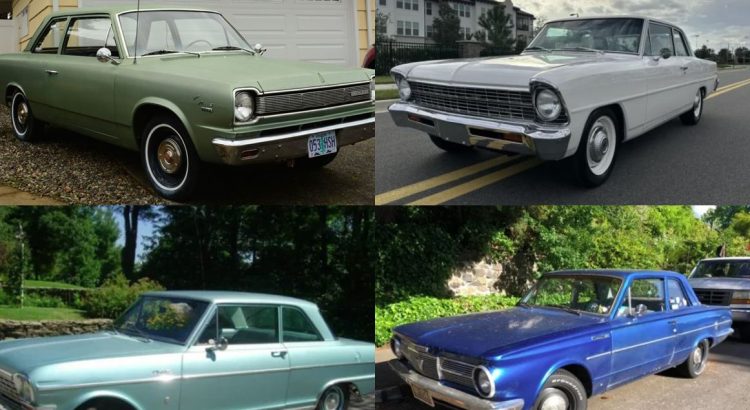
Among these models, the Rambler American 1966 stands out with a 0 to 60 mph time of 9.3 seconds, while the Chevy II 1967 and the Valiant 1965 closely follow, both offering impressive performance for their time. The Gremlin and the Camaro, although slightly slower, also demonstrate that six cylinders can hold their own against V8s in terms of performance.
This exploration of six cylinders reminds us that innovation is not reserved for powerful engines; sometimes, simplicity and efficiency can lead to equally impressive results.
A hopeful conclusion for six-cylinder enthusiasts
While V8 engines still dominate the muscle car market, six cylinders have proven they deserve their place in automotive history. These often-overlooked engines continue to attract the attention of enthusiasts and collectors, testament to an era where every horsepower counted and where each model had a unique personality.
For all those who appreciate automotive culture and the passion for collecting, these six-cylinder models represent a wonderful opportunity to explore a fascinating chapter of American automotive history.