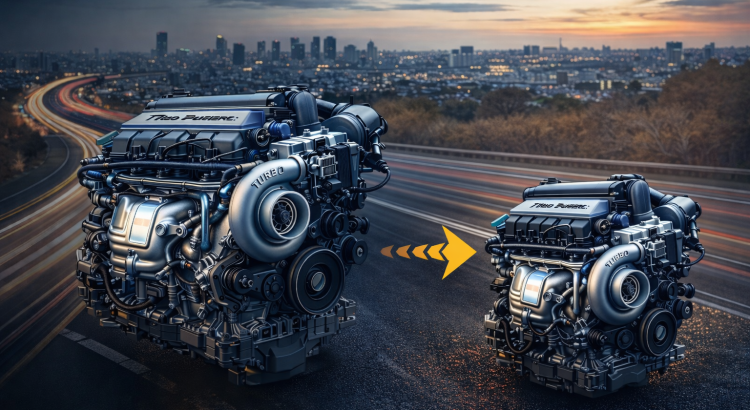
Since the early 2010s, automobile downsizing has emerged as a major technical response to the environmental and regulatory constraints facing the automotive industry. Reduction of engine displacement, widespread use of turbocharging, promise of equivalent performance with reduced fuel consumption and CO₂ emissions: on paper, downsizing seemed to be the ideal solution.
However, with hindsight and the experience of drivers, this engine strategy raises many questions today. Real consumption, reliability, driving pleasure, adaptation to heavy vehicles… downsizing is as divisive as it is intriguing. This pillar article offers a comprehensive, objective, and in-depth analysis to understand what downsizing really is, why it has been widely adopted, as well as its limitations and future.
What is automobile downsizing?
Downsizing involves reducing the displacement of an internal combustion engine while maintaining a performance level comparable to that of a larger engine. This reduction is made possible through the use of technologies such as turbocharging, high-pressure direct injection, advanced electronic management, and optimization of thermal efficiencies.
In practical terms, an old 2.0-liter naturally aspirated engine is replaced by a 1.2 or 1.3-liter turbo engine, showing equivalent or even superior power on the technical specifications.
👉 To understand in detail the technical functioning of downsizing: Engine downsizing: simple definition and explained functioning
Why have manufacturers widely adopted downsizing?
Downsizing is not an isolated choice but the direct consequence of several factors:
- the gradual tightening of European anti-pollution standards (Euro 5, Euro 6, then Euro 7),
- the fight against CO₂ emissions, used as a tax criterion in many countries,
- homologation cycles (NEDC then WLTP) historically favorable to small displacement engines,
- strong competitive pressure on announced consumption figures.
Under these conditions, downsizing has become an almost unavoidable industrial solution, sometimes pushed to the extreme.
👉 Comprehensive analysis of this strategy: Why manufacturers have generalized engine downsizing
The advantages of downsizing on paper
Theoretically and regulatory-wise, downsizing presents several undeniable advantages:
- a reduced consumption during homologation tests,
- lower CO₂ emissions, limiting ecological penalties,
- more compact and lighter engines,
- torque often available earlier thanks to turbocharging.
These qualities make downsizing particularly suitable for smooth and anticipatory driving, especially in urban and suburban environments.
Downsizing and real consumption: a often observed gap
In practice, many drivers notice a discrepancy between announced consumption and real consumption. More frequently solicited, downsized engines often operate at high loads, which can negate theoretical gains.
On highways, in mountains, or during hard accelerations, a small turbo engine can consume as much, if not more, than a larger displacement engine.
👉 Detailed breakdown: Downsizing and real consumption: why the gap with official figures
Reliability of downsized engines: what you really need to know
Downsizing imposes significant mechanical constraints: high pressures in the cylinders, increased temperatures, heavily stressed turbos. Not all downsized engines are equal in facing these constraints.
The reliability of a downsized engine heavily depends on:
- its initial design,
- adherence to maintenance intervals,
- driving style,
- the vehicle in which it is installed.
👉 In-depth analysis: Downsized engine and reliability: what you really need to know
The downsized engine in daily life: for what uses is it suitable?
In urban use or on short trips, downsizing can prove effective and pleasant. However, on long journeys, with a loaded vehicle or towing a trailer, its limitations become apparent more quickly.
👉 Analysis by type of use: Downsized engine in daily life: city, highway, load, and long trips
Downsizing and SUVs: a complex equation
Combining downsizing with heavy and aerodynamically inefficient SUVs poses a real problem of coherence. In these conditions, the engine is often operated under heavy load, which increases consumption, wear, and sometimes noise discomfort.
👉 Dedicated file: Downsizing and SUVs: is the engine really suitable?
Gasoline or diesel downsizing: two different logics
Downsizing does not apply in the same way to gasoline and diesel engines. Thermal constraints, low-end behavior, and longevity differ significantly depending on the fuel.
👉 Detailed comparison: Gasoline or diesel downsizing: what are the differences in use?
Maintenance of a downsized engine: a crucial point
More than a conventional engine, a downsized engine requires rigorous maintenance: quality oil, adherence to warm-up times, and appropriate driving after heavy use.
👉 Mistakes to avoid: Maintaining a downsized engine: mistakes to avoid
From downsizing to right-sizing: a return to balance
In response to the excesses of downsizing, some manufacturers are beginning to shift towards right-sizing, a more balanced approach that involves adapting engine displacement to the vehicle and its actual use.
👉 Analysis of this evolution: From downsizing to right-sizing: the return to more coherent engines
Downsizing and hybridization: a logical transition
Mild or full hybridization can help compensate for some downsizing weaknesses, particularly at low revs or during high-demand phases. In this context, downsizing becomes more relevant.
👉 Breakdown: Downsizing and hybridization: sustainable solution or simple transition?
Buying a downsized engine car: a good choice?
Downsizing is neither a scam nor a universal solution. When well-chosen and suited to the use, it can prove relevant. Poorly sized, it can conversely generate frustration and maintenance costs.
👉 Our advice before buying: Buying a downsized engine car: good or bad choice today?
Conclusion: downsizing, a transitional solution
Automobile downsizing has allowed manufacturers to quickly respond to environmental constraints. But its limitations are now well identified. More than an end goal, it appears as a transitional solution, set to evolve towards better-sized and more electrified powertrains.