
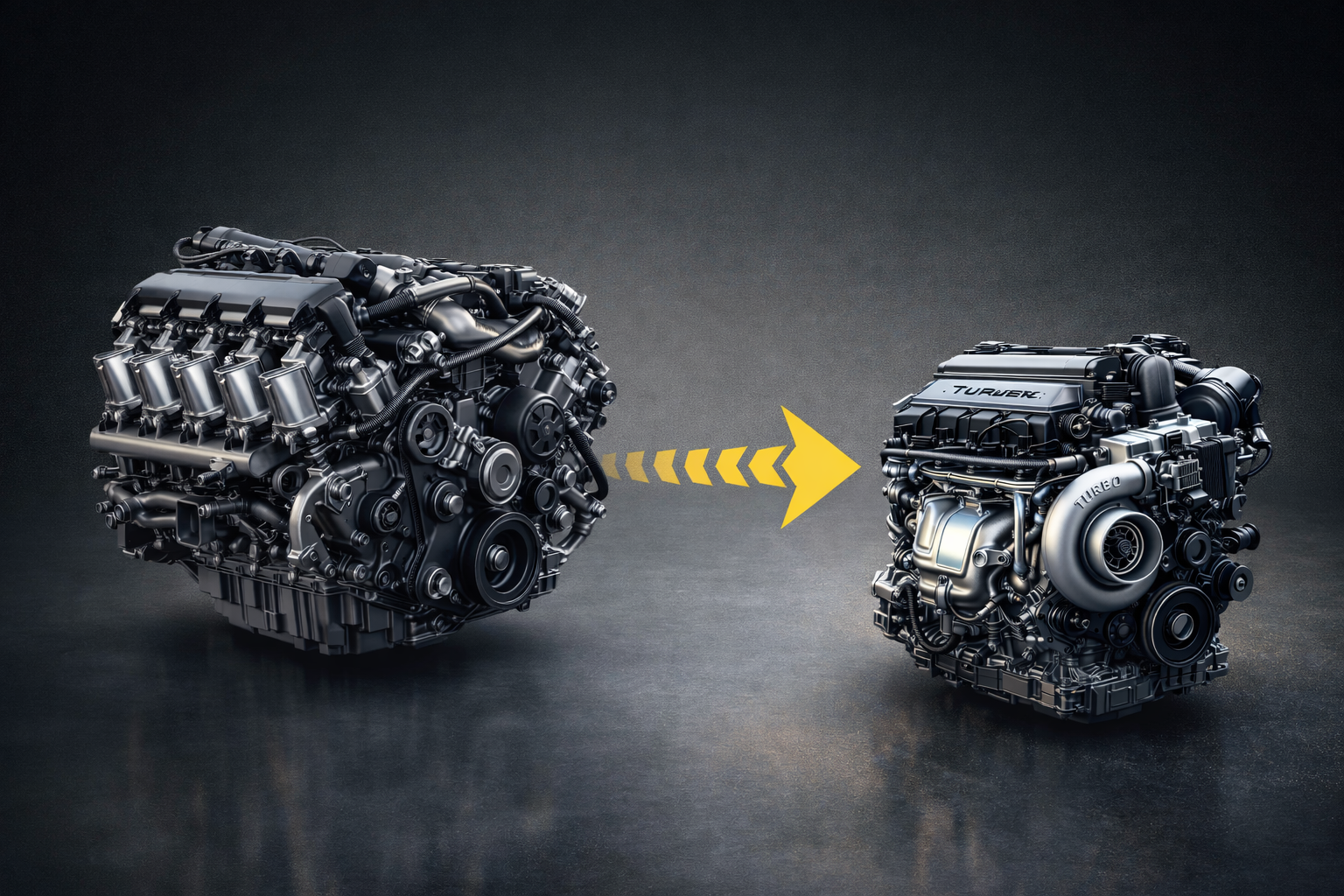
The engine downsizing has become an essential term in the automotive world. Present in most modern cars, it is often associated with promises of reduced fuel consumption, lower CO₂ emissions, and performance equivalent to that of larger engines. But what does engine downsizing really mean, and how does it actually work?
In this article, we offer you a simple and clear definition of engine downsizing, as well as a detailed explanation of its functioning, without unnecessary jargon.
What is engine downsizing?
Engine downsizing involves reducing the displacement of an internal combustion engine while maintaining a comparable level of power and torque to that of a larger engine. To achieve this, manufacturers rely on modern technologies such as turbocharging, direct injection, and advanced electronic management.
Specifically, a naturally aspirated engine of 1.8 or 2.0 liters has gradually been replaced by an engine of 1.2 or 1.3 liters, often turbocharged, showing similar performance on paper.
👉 For a comprehensive overview of the topic: Automobile downsizing: principle, advantages, limitations, and future of modern engines
Why do we talk about “downsizing”?
The term “downsizing” comes from English and literally means reduction in size. Applied to the automotive engine, it refers to the desire to:
- reduce displacement,
- limit the number of cylinders,
- decrease weight and internal friction,
- optimize energy efficiency.
The goal is clear: to do better with less, at least in theory.
How does a downsized engine work?
The functioning of a downsized engine relies on several technological pillars:
The turbo as a central element
The turbo allows for an increase in the amount of air admitted into the engine. By compressing the incoming air, it enables more fuel to be burned in a reduced displacement, thus increasing power.
Direct injection
High-pressure direct injection optimizes combustion by injecting fuel directly into the combustion chamber. This improves efficiency and allows for better control of emissions.
Advanced electronic management
Modern controllers continuously adjust turbo pressure, ignition timing, and the amount of fuel injected to optimize performance and consumption.
Engine downsizing and performance: myth or reality?
On paper, a downsized engine often shows very flattering power and torque figures. Torque is generally available earlier, giving a sense of dynamism at low revs.
However, these performances are highly dependent on:
- engine speed,
- turbo pressure,
- driving style,
- vehicle weight.
👉 To understand the gaps between theory and reality: Downsizing and real consumption: why the gap with official figures
Engine downsizing and reliability: a key issue
Reducing displacement while maintaining good performance involves greater mechanical constraints. High pressures, increased temperatures, and constant turbo stress can impact longevity.
Not all downsized engines are equal in facing these constraints.
👉 Complete analysis: Downsized engine and reliability: what you really need to know
Is engine downsizing suitable for all uses?
Engine downsizing is particularly relevant:
- in urban driving,
- on short and suburban trips,
- for smooth and anticipatory driving.
In contrast, it may show its limits:
- on highways at high stabilized speeds,
- with a loaded vehicle,
- in mountainous areas or during towing.
👉 Detailed analysis by type of use: Daily downsized engine: city, highway, load, and long trips
Engine downsizing: a step, not an end
Engine downsizing is part of a transition logic. In light of its limitations, some manufacturers are now starting to return to more coherent engines, better sized for the vehicle: the right-sizing.
👉 Also read: From downsizing to right-sizing: the return to more coherent engines
Conclusion
Engine downsizing is neither a perfect revolution nor a total mistake. It is a technical response to regulatory constraints, which can be relevant if well designed and well used. Understanding its functioning allows for better vehicle choice and adapting driving to get the most out of it.

