

Former Haas team principal Günther Steiner believes Formula 1 needs to reform its stewards’ regulations, questioning the excessive delays in handing out post-race penalties. He points to the recent Miami Grand Prix and incidents involving Max Verstappen and Charles Leclerc as examples, sparking debate about the efficiency and clarity of decisions made long after the chequered flag.
F1: A race against time for penalties?
The 2026 Miami Grand Prix left a sour taste, not just on the track but also in the stewards’ offices. After the chequered flag fell, several incidents required in-depth analysis, including suspicions of Max Verstappen crossing the pit exit line, a collision between the Dutchman and George Russell, and contact between the latter and Charles Leclerc. The final decisions, announced more than two and a half hours after the race concluded, saw Leclerc penalised 20 seconds for cutting several corners on the final lap. This delay has raised eyebrows, and not just among casual observers.
Steiner calls for a time limit on sanctions
Speaking on The Red Flags podcast, Günther Steiner, a prominent figure in F1, expressed his surprise at the lengthy decision-making process. “I was already on the plane home when I heard there were still penalties to be decided,” he revealed. “I think there needs to be a time limit. If you don’t know what to do, don’t give a penalty.” This statement highlights a growing frustration with how incidents are managed, raising questions about the relevance of decisions made so long after the events. For the former team principal, the stewards’ objective should be to act during the race, not to become late-stage spectators.
Stewards to decide, not just watch
Steiner insists that the primary role of stewards is to make decisions on racing incidents, not simply to observe the spectacle. “What are they doing during the race?” he questioned. “They are there to make decisions on what goes wrong.” He suggests a more proactive approach: red-flagging the race at specific moments to allow stewards to analyse and rule on contentious incidents quickly. The idea is not to let doubt linger for too long, transforming their task into a post-event analysis rather than a live intervention. The show, in his view, should not be their priority.
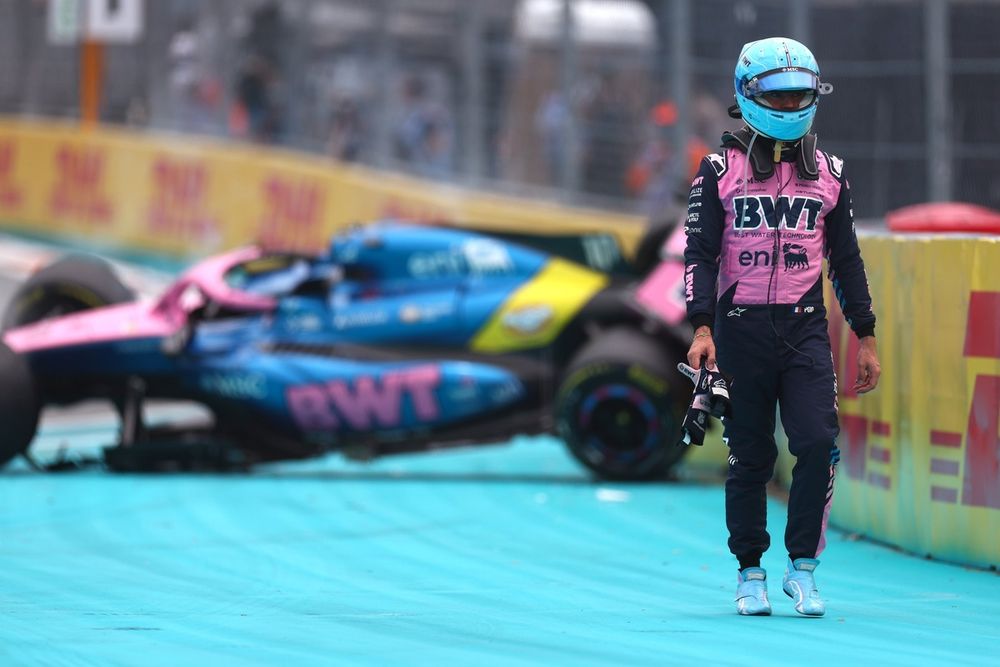
Pierre Gasly after his collision with Liam Lawson.
The Verstappen case: A white line, a clear decision?
Max Verstappen’s case, penalised five seconds for crossing the pit exit line, perfectly illustrates Steiner’s point. “Crossing a white line, what’s there to contest? Either it happened or it didn’t. There are cameras, and then the team always has the option to lodge a protest.” For Steiner, such situations should be settled instantly, without debate. He contrasts these cases, which he describes as “black and white,” with more complex incidents, like the one involving Pierre Gasly and Liam Lawson, which require more in-depth analysis. Current technology, he believes, should allow for immediate action on such tangible facts.
Stewards’ justification: Limited evidence
In response to these criticisms, F1 stewards attempted to justify their decision-making delay. In their verdict regarding the Verstappen case, they explained that the video evidence available at the time of the incident was limited for making a clear decision. They therefore opted for a post-race analysis to search for additional camera angles. “We were able to do so,” they specified, implying that the wait allowed for the gathering of conclusive evidence. While this explanation highlights the difficulties faced by officials, it doesn’t entirely dispel the feeling that F1 is sometimes too slow to react.
Towards a more responsive F1?
- Formula 1 could introduce a maximum time limit for stewards’ decisions.
- The aim is to improve the clarity and speed of sanctions, avoiding lengthy post-race waits.
- Stewards should focus on real-time decisions rather than retrospective analysis.
- Simple incidents, such as crossing lines, should be judged instantly thanks to technology.
- A more responsive F1 would enhance credibility and the spectacle, without leaving lingering doubts.
[quoi faire][en tant que spectateurs][diffusion TV de la][Pierre][Liam]


