

McLaren’s gamble on intermediate tyres backfires spectacularly at Canadian GP
Formula 1 is a sport of split-second decisions, and the 2026 Canadian Grand Prix provided a stark reminder of that. McLaren, through its team principal Andrea Stella, has attempted to explain a bold strategic call on intermediate tyres at the start of the race, a strategy that quickly unravelled for Lando Norris and Oscar Piastri, severely hampering their chances.
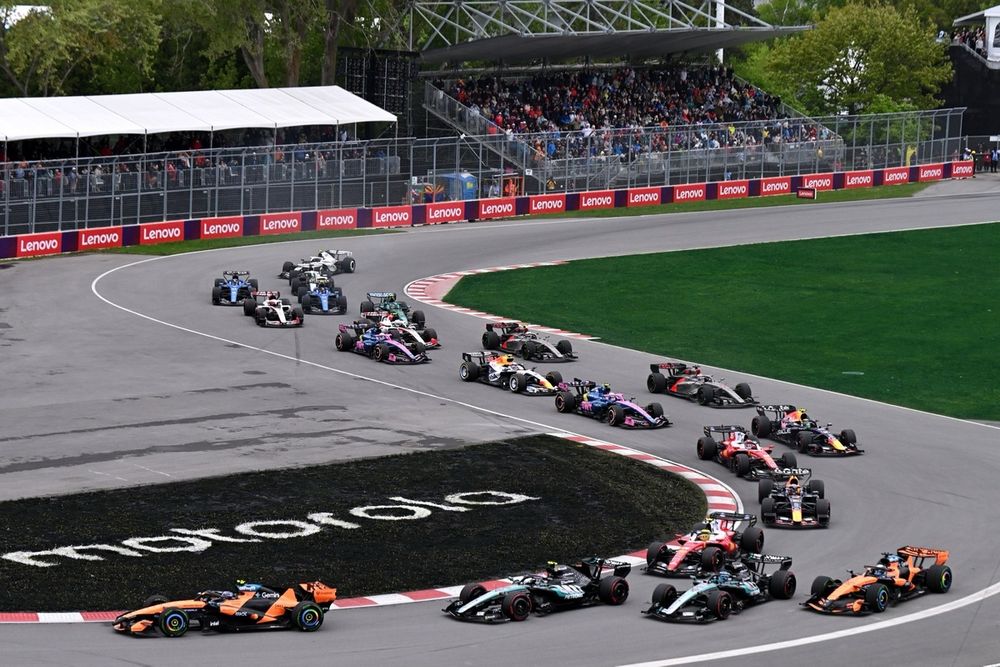
Lando Norris took the lead of the Canadian GP thanks to his tyres.
A Wet Start, A Risky Bet
The Canadian morning had been drenched, but the skies miraculously cleared before the Grand Prix got underway. At Montreal’s Circuit Gilles-Villeneuve, the majority of the grid, confident in the drying conditions, opted for slick tyres. Only the two McLaren drivers, Lando Norris and Oscar Piastri, positioned on the second row, made a radically different choice: intermediate tyres. A decision that, in hindsight, proved to be a costly strategic gamble, rapidly transforming a potential advantage into a significant handicap.
The Unpredictable Joker of Weather
McLaren team principal Andrea Stella defended the decision post-race, explaining it was made amidst uncertain conditions. “The track was slick. We were already struggling to keep tyre temperature on a dry track, but at that moment, it was slick and raining,” he argued. The team therefore felt intermediate tyres were the most suitable choice at the time of the decision, five minutes before the start. An explanation that attempts to rationalise a choice which, judging by the results, appears to have been a missed poker gamble.
Double Formation Lap Aggravates the Situation
McLaren’s team principal also pointed to the two extra formation laps imposed following a breakdown for a Racing Bulls car. These laps, intended to allow drivers to better assess the track and warm their tyres, had the opposite effect for McLaren. They nullified any potential advantage the intermediate tyres might have offered in the initial conditions, allowing the track to dry more quickly and the slick tyres of their rivals to gain efficiency. “I would have been very curious to see the dry-shod cars if the race had started on time,” Stella commented, leaving one to ponder what might have been.
Norris Leads, Then the Trap Springs Shut
Paradoxically, McLaren’s gamble initially seemed to pay off. Lando Norris, benefiting from the better grip offered by his intermediate tyres, managed to snatch the lead of the race right from the start, gaining an initial advantage over his pursuers. But this advantage was short-lived. The track, continuing to dry visibly, quickly rendered the intermediate tyres ineffective. Norris and Piastri were forced to pit for medium tyres, losing precious time and compromising their chances of a strong result.
A Grim Picture for the Teammates’ Race
The rest of the race was a profound disappointment for McLaren. Oscar Piastri, attempting to recover after his pit stop, unfortunately collided with Alexander Albon, ending his race prematurely. Lando Norris, meanwhile, had to retire due to a mechanical issue, sealing a dismal weekend for the Woking squad. A catastrophic scenario that starkly contrasts with the hopes generated by Norris’s pole position in qualifying.
The Difficult Lesson of Decision-Making
Andrea Stella stressed the difficulty of assessing strategic decisions solely on the final outcome. “You always have to be cautious when judging decisions purely on the result,” he reminded. He highlighted that the decision was made in a very short timeframe, with limited information and fluctuating weather. Had the rain persisted for a few more minutes, the choice of intermediate tyres could have proven astute. But F1 is also a game of luck, and this time, it did not smile on McLaren.
Key Takeaways for McLaren from the 2026 Canadian GP:
- An audacious strategic gamble on intermediate tyres at the start proved costly.
- Changing weather conditions and extra formation laps worked against McLaren.
- Oscar Piastri retired after contact with Alexander Albon.
- Lando Norris also had to withdraw due to a mechanical problem.
- The difficulty of retrospectively evaluating strategic choices.
- F1 remains a sport where luck plays a significant role.


