

Kimi Antonelli’s poor sprint start in Miami did more than shuffle the order: it exposed a wider problem for Mercedes. The team has now cleared its young driver of the blame, while admitting that part of the issue came from its own side. In plain terms, the Silver Arrows left Florida with a story about messy starts, but also with an awkward reminder that they are still behind McLaren, Ferrari and Red Bull on outright pace.
[[AUTONOME_IMG_X]]
Before getting into the details, it is worth stepping back to the Formula 1 category: Miami was not just a case of Mercedes chasing the leaders, but of Mercedes chasing answers of its own. A missed launch, a scrappy internal battle and a pecking order already shaped by rival development all point to a team that is still not quite where it wants to be this season.
Antonelli loses ground again at the start
The numbers make for grim reading, and not for the first time. After five starts, Antonelli had already lost 20 places in total on the opening lap, which suggests a genuine weakness when the lights go out and traction becomes everything. The Miami sprint followed the same pattern, with the Italian slipping from second to fifth between the start and the first corner.
Normally, Antonelli is quick to own his mistakes. This time, the picture was different. He said he had followed the procedures correctly, but also described grip as “very low”, and likely lower than expected. That matters, because in Formula 1 a launch can be decided in a handful of metres, and any weakness there is brutally obvious.
Mercedes admits the fault was on its side
The key takeaway from the weekend is that Mercedes eventually accepted the problem was not entirely down to the driver. The team described it as “a problem on its side”, making clear that it was “absolutely not Kimi’s fault”. In a paddock where every word is weighed carefully, that is as close as you get to a technical admission.
It also matters because it protects a rookie who is naturally going to be judged on visible errors. If the team is willing to put its hand up for a flaw in the car or in the way it is being operated, the conversation shifts. This is no longer just about a young driver learning on the job; it is about a Mercedes that has not yet fully nailed the basics at the start of races. At this level, even a small misstep is expensive.
A sprint that also exposed Mercedes’ true level
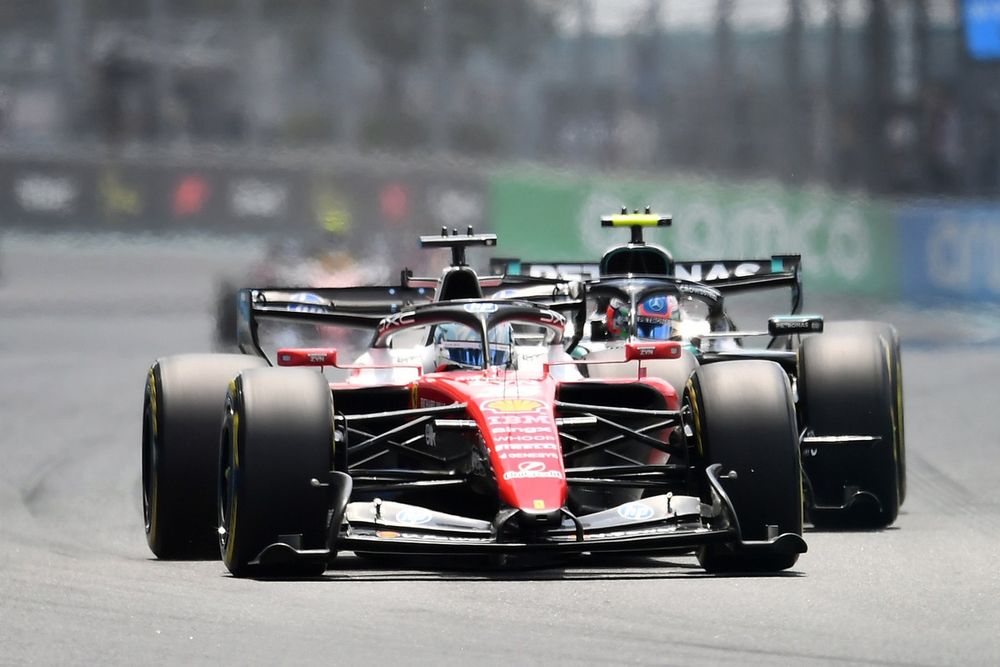
The uncomfortable part for Mercedes is that Antonelli’s start was not the whole story. The sprint as a whole was underwhelming. Expected to be more competitive in the pack, the German outfit spent much of the race fighting itself rather than threatening Charles Leclerc’s Ferrari, and it was nowhere near the McLarens, which looked in a class of their own this time.
In truth, Mercedes came across as a team that was solid enough, but not especially dangerous. That is often where the real story of a weekend lies: when the pre-race ambitions no longer match the pace on track, the result becomes almost secondary. Mercedes limited the damage, but it did not shape the race.
Penalties and track limits made the result look worse
The final classification made the weekend look even less tidy. Antonelli was originally classified fourth, with Russell fifth, but the Italian dropped to sixth after a penalty for repeated track-limits offences, allowing his team-mate to move up a place. Once again, this was not simply a difficult race; it was a messy one.
Antonelli did not hide behind excuses. He said he was very frustrated, admitted he had not driven well and accepted that he had made too many mistakes. The message is straightforward: if poor starts are followed by excursions beyond the white lines, the weekend quickly becomes a collection of little losses. In a sprint, where there is barely time to recover, that is enough to ruin the result.
Russell confirms a low-grip circuit
Russell also underlined how tricky Miami can be. The Briton said there is very little grip at this circuit, comparing it with other low-adhesion venues on the calendar such as Brazil and Zandvoort. That is not a trivial point: when all four corners are sliding, drivers lose confidence and the chassis no longer forgives much.
Even so, Russell salvaged something by finishing fourth after gaining two places from where he started. His comments are useful because they put the sprint into context. He felt the progress made by McLaren, Ferrari and even Red Bull was significant. In other words, Mercedes is not just dealing with its own shortcomings; it is facing rivals who have clearly moved on.
Mercedes chose to wait on its upgrades
The pace deficit in Miami did not come out of nowhere. Mercedes has chosen to hold back the bulk of its upgrades until the Canadian Grand Prix, while its rivals brought new parts to Florida. In a development race this tight, that sort of timing shows up immediately on the stopwatch.
Toto Wolff admitted as much, saying the team knew it was behind in its upgrade schedule, but still hoped to keep pace on track. He also ruled out any link with the recent regulatory changes. For him, this is mainly a development battle, where a few tenths gained early can make all the difference. The verdict is harsh, but familiar: in Formula 1, wait too long and you are already playing catch-up.
What Miami really tells us about Mercedes
In the end, this sprint summed up Mercedes’ position rather neatly at this point in the season: a rookie learning the hard way, a team leader grinding away, and a car that still does not appear to be in its best operating window. Nothing catastrophic, but enough to send a clear message that the margins are thin and the front-running teams have already edged ahead.
- Antonelli again lost ground at the start, although this time Mercedes accepted part of the problem came from the car.
- The team made clear that the fault was not the driver’s.
- Miami mainly exposed Mercedes’ lack of pace against McLaren and Ferrari.
- Track-limits penalties made the final result look even less tidy.
- Mercedes has delayed its major upgrades until Canada, and that gap is already visible on track.
- For the next few rounds, the priority is simple: improve the starts and bring performance in at the right time.


