


The world of Formula 1 is buzzing with the announcement of the partnership between Red Bull Powertrains and Ford. As preparations for the 2026 season intensify, questions surrounding the legality of the new engines are multiplying, adding a dose of suspense to this already thrilling competition.
A promising yet concerning partnership
With Red Bull’s presentation in Detroit, the marriage between Red Bull Powertrains and Ford is taking shape. This partnership, although recent on paper, saw its first work begin four years ago on the Milton Keynes campus. Much like an arranged marriage that could ultimately blossom into a beautiful love story, it remains to be seen whether this couple will truly be competitive upon their entry into the grand arena of Formula 1.
The big question that lingers concerns the ability of a newcomer to compete in such a seasoned pack. Indeed, with the rise of electric power in the new regulations, Red Bull and Ford will have to juggle their relative inexperience in this area while absorbing the demands of Formula 1.
The mystery of the compression ratio
As the winter testing in Barcelona approaches, all eyes are on the thermal engine, and more specifically on a crucial parameter: the compression ratio. For 2026, this has been lowered from 18:1 to 16:1, a decision aimed at making the rules more accessible to new engine manufacturers. In theory, this should level the playing field, but in practice, the reality could be quite different.
Red Bull’s rivals, notably Audi, Ferrari, and Honda, have not been idle. They have raised doubts regarding the compliance of Red Bull and Mercedes during static tests at ambient temperature, which are currently the only control method used by the FIA. They fear that teams may exploit higher temperatures to exceed the allowed compression ratio when the engines are running. Much like a student cheating on an exam using a smartphone hidden under the table.
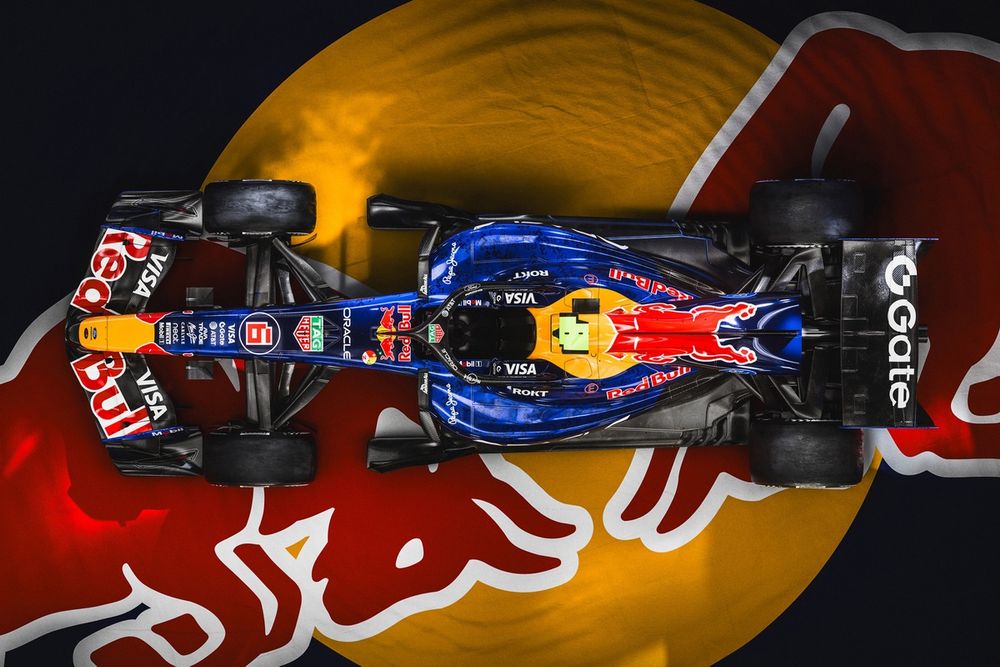
The 2026 livery of Red Bull Racing
Confidence or arrogance?
Ben Hodgkinson, director of Red Bull Powertrains, attempted to allay concerns during a meeting with a select group of journalists, including Motorsport.com. His confidence was palpable: according to him, the new power unit is fully compliant with the regulations. For him, all this noise surrounding doubts about legality is “almost entirely just noise.” A statement that could be interpreted as bravado or simply well-placed assurance.
“I know what we are doing, and I am confident that it is legal. Of course, we have pushed the limits of the regulations. I would be surprised if everyone hasn’t done the same. My honest feeling is that it’s a lot of noise for nothing.”
However, the reality is more nuanced. The various engine manufacturers seem to interpret the Technical Regulations divergently. Article C5.4.3 states that checks are carried out with the engine stopped and at ambient temperature, allowing Red Bull and Mercedes to claim their compliance. In contrast, their rivals point to Article C1.5, which specifies that the cars must comply with the entirety of the regulations at all times during a competition. A true game of poker where each tries to bluff the other.
A contested limit
In this context, Hodgkinson expresses his reservations regarding the new compression ratio. In his view, the reduction to 16:1 is an unnecessary decision. “From a purely technical standpoint, this limit is too low. We have the technology to make combustion fast enough,” he states, adding that a ratio of 18:1 could easily be achievable with current technological advancements.
He even goes so far as to assert that each manufacturer should aim for a ratio as close as possible to 15:999 when measured. This clearly shows that in the ruthless world of Formula 1, every millisecond counts, and innovation is constantly in pursuit of performance.
Conclusion: an uncertain yet promising future
As the 2026 season approaches rapidly, concern and excitement mingle among fans and stakeholders in motorsport. The partnership between Red Bull and Ford could well redefine the codes of competition, but only if the two giants manage to skillfully navigate the maze of new regulations and fierce rivalries. In the meantime, the tension is rising, and all eyes will be fixed on the circuit, ready to seize every moment of a season that is already shaping up to be historic.


