

Kimi Antonelli has done it again in Miami, but Toto Wolff is in no mood to let Mercedes get carried away. The 19-year-old’s run of victories has put the team in an unusually strong position, yet in Formula 1 that is exactly when caution matters most.
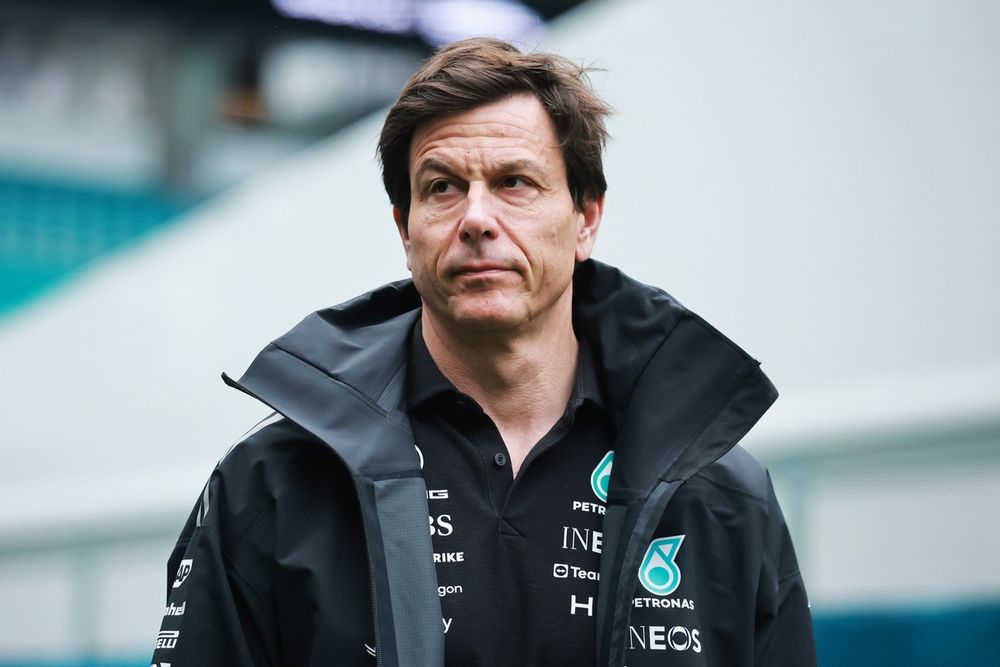
Wolff’s message after Antonelli’s win was straightforward: the form is excellent, but nobody at Brackley should mistake momentum for certainty. A strong start to the season is useful, of course. It is not, however, a substitute for keeping the development programme moving, particularly with the fight at the sharp end likely to be decided as much in the factories as on the circuit.
Antonelli keeps turning pole positions into wins
At Miami, Antonelli once again did what he now appears to do almost casually: start from the front and leave everyone else to sort themselves out. Pole became victory, just as it had in China and Japan. Three poles, three wins. For a driver who only turned 19, that is a remarkable return and one that is already forcing rivals to take him seriously.
What stands out most is not just the sequence, but the way it has shaped the championship picture. Since Suzuka, Antonelli has led the drivers’ standings and now holds a 20-point advantage over team-mate George Russell. In a paddock with the memory of a goldfish, that sort of consistency changes the tone very quickly. Rivals start asking different questions. Mercedes, meanwhile, has to deal with the slightly less glamorous issue of expectation.
Mercedes wants pace without the self-congratulation
Wolff was not trying to dampen the result, merely to keep it in proportion. His argument is a familiar one: a team that starts strongly can too easily assume the trend will continue by itself. In Formula 1, though, a car that feels spot-on one weekend can feel far less convincing the next. Wolff has seen enough seasons to know that better than most.
His warning is aimed both inside and outside the garage. Externally, it is about avoiding any sense that the job is done. Internally, it is about keeping the team focused on the next step, because the opposition is never far away. Wolff also pointed out that Antonelli has a very capable reference point alongside him in Russell. The Briton was not happy with how the car behaved over the weekend, which is a useful reminder that the Mercedes garage is not exactly a placid place when the lights go out.
Russell’s feedback matters as much as the victories
That is where Wolff’s stance becomes more interesting. Mercedes could choose to frame Antonelli’s form as proof that everything is working. It does not, and there is good reason for that. As long as Russell remains in the picture, the team cannot afford to become complacent about the car’s behaviour. A front end that suits one driver may not be so cooperative for the other, and in F1 that kind of difference can reshape an entire weekend.
By stressing Russell’s dissatisfaction, Wolff also avoids one of the classic traps of a hot run: treating the result of one driver as an absolute verdict on the package. Mercedes may well have a strong car, as Wolff suggests, but that does not mean it is beyond question at every circuit or in every condition. Formula 1 punishes certainty rather quickly.
Development will decide whether Mercedes can sustain it
The next important checkpoint comes in Canada on 24 May, when Mercedes is due to introduce planned upgrades. Even there, Wolff is keeping the language deliberately sober. New parts do not always show their value immediately on the stopwatch. On paper, the logic may be sound; on track, the answer can be far less kind.
That matters because it puts the season into proper context. For Wolff, this is a development race, with the real question being how much each team can still bring and how effectively it can do so within the budget cap. In other words, the current standings tell only part of the story. The bigger test is whether Mercedes can keep improving without using up its resources too early. Modern Formula 1 is not just about being quick. It is about staying quick.
Miami gives Antonelli a place in the record books
Beyond the immediate run of results, Antonelli has also written himself into a stat that will be mentioned for a long time: he is the first driver in history to convert his first three pole positions into victories. That does not happen by accident. It says plenty about his composure, his race control and his ability to deliver when the pressure is on.
Even so, Antonelli is not behaving like someone determined to linger in the spotlight. His post-race message was measured enough: this is only the beginning, he said, and the plan is to enjoy the moment before getting back to work. That tone fits neatly with Wolff’s own view. No grand statements, no overblown talk of destiny. Just a young driver doing the job, and a team trying hard not to tell itself a fairy story.
Mercedes has momentum, but the real test starts now
Miami has given Mercedes more than a win. It has given the team proof of concept, a new leading figure and a sequence that will inevitably draw attention. Wolff is right to keep the lid on the excitement, though. A Formula 1 season is rarely won off the back of three tidy weekends. It is won through the long grind: how rivals respond, whether upgrades work, and whether a team can keep its nerve when everybody starts looking at it differently.
In short, Mercedes has earned the right to believe. It has not earned the right to assume. The next few races will tell us whether Antonelli can extend this run and whether Brackley can turn an excellent start into a genuine title challenge.
- Antonelli won the Miami Grand Prix after taking pole position.
- He now has three consecutive wins, after China and Japan.
- The 19-year-old has led the drivers’ championship since Suzuka and is 20 points clear of George Russell.
- Toto Wolff is urging caution and refusing to get carried away by Mercedes’ recent form.
- Mercedes expects its next updates at the Canadian Grand Prix on 24 May.
- The team sees the season as a development battle under the budget cap.


