

Verstappen finds pace in Monaco but energy management still a hurdle
In Monaco, Max Verstappen rediscovered a Red Bull capable of fighting for the front row, an unexpected performance after practice. While the Dutchman savoured this return to form, he once again pointed to engine management as a factor preventing him from fully expressing himself.
Monaco has a unique quality of sometimes revealing surprises, even for the most dominant teams. This was the case this Saturday for Max Verstappen and Red Bull. After a mixed free practice session, where the four-time Dutch world champion oscillated between hope and frustration, the qualifying session turned in his favour. Despite fierce competition, he secured a front-row start, just a breath away from pole position.
High-tension Monaco qualifying
Qualifying on the Rock is always a perilous exercise, where the slightest mistake is costly. This was true for Ferrari, who were far from expectations, leaving the stage open for an unexpected duel between Kimi Antonelli, the championship leader, and Max Verstappen. The Red Bull, after technical adjustments, suddenly regained its verve in the Dutchman’s hands. He had to contend with traffic and the barriers, but the result is there: a front-row start, a significant gain for the race.
“If you had told me yesterday that we would be on the front row, I would have signed up immediately,” Verstappen confided, relieved, after exiting his car. “This morning, I think we had quite a few difficulties with the car, so being at the front in qualifying is extremely positive.” It must be said that after a disappointing FP3, where he was nearly a second off Antonelli’s Mercedes, this return to the forefront is almost an achievement. The RB22, in warmer track conditions, seemed to find a second wind, allowing its driver to set a lap that could have propelled him to pole.
Verstappen impressed by 2026 cars… with a caveat
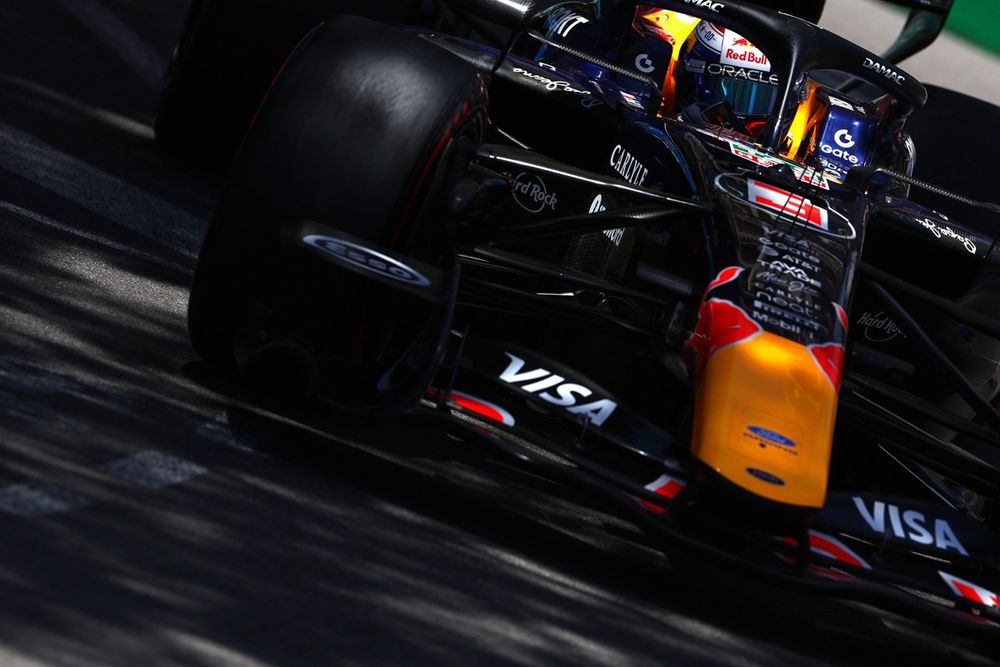
Max Verstappen (Red Bull Racing)
Beyond the raw result, it’s the driver’s feedback that captures attention. The narrower and lighter 2026 cars seem to have won over the Dutchman, who has been one of the most vocal critics of the new engine regulations. In Monaco, where energy management is less critical than on other circuits, he was able to fully exploit his car’s potential. “These cars are more on the limit than, say, in recent years,” he analysed. “And with the power coming in, as well as the behaviour and gear changes, everything is a bit different.”
This return to control, where the driver has more latitude in choosing gears in corners, allowed him to “feel like himself again”. A statement that, implicitly, continues to highlight the limitations imposed by the electronic management of current engines. “I could finally feel like myself again in the car, let’s put it that way, using the gears as I wanted,” he specified. “Unfortunately, obviously, you can’t do that on many circuits on the calendar, but it certainly makes driving more and more natural.”
The engine management dilemma
While Verstappen appreciates the increased agility of the future cars and the ability to dictate his own driving, the core issue remains energy management. In Monaco, kinetic energy recovery is facilitated by the circuit’s sinuous profile, allowing drivers to rely less on their power units. It is in this context that he was able to rediscover lost sensations, those of a more instinctive and less algorithm-constrained driving style.
“I think the chassis regulations aren’t too bad. Overall, the slightly narrower cars and all that, I think it’s good,” he added. “And I also appreciate that the forward visibility is a bit better in the corners, compared to what we had above the tyre before. So yes, it’s good.” The contrast is striking: on one hand, technical regulations that seem to be heading in the right direction for driving pleasure; on the other, engine management that stifles driver expression.
A front-row start as an achieved objective
Despite this persistent frustration regarding engine management, Verstappen is generally satisfied with his qualifying performance. A front-row start in Monaco, especially after the doubts from practice, represents an undeniable success. He knows the race will be lively, with rivals seeking redemption and the specificities of the Monaco circuit. Starts are always tricky, and the presence of fast cars directly behind him is a factor not to be overlooked.
“Happy to be on the front row, and then tomorrow, we’ll see at the start,” he concluded. “These cars are quite complicated off the line, I have two cars behind me
that start quite well, but we’ll see. It was a good day and I really enjoyed qualifying.” Hope is therefore permitted for the Dutchman, who hopes to convert this fortunate qualifying position into a victory on the Rock, despite the technical constraints.
Key takeaways from Verstappen’s Monaco qualifying:
- Unexpected return to form: Red Bull and Verstappen rediscovered their competitiveness, securing a front-row start in Monaco.
- Rediscovered driving pleasure: The Dutchman appreciated the narrower 2026 cars, which allowed him to regain his feel for driving.
- Persistent criticism of engine management: Verstappen still laments the limitations imposed by electronic management, which prevent him from fully expressing himself.
- Front-row start as an achieved goal: Despite the constraints, Verstappen is satisfied with his starting position for the race.
- Uncertainty at the start: Managing the first corner and the competition from other teams remain unknowns for the race.
[les Ferrari de Lewis Hamilton et Charles Leclerc]
Related articles about Dodge Monaco
Selection of articles, guides and advice about Dodge Monaco.


