
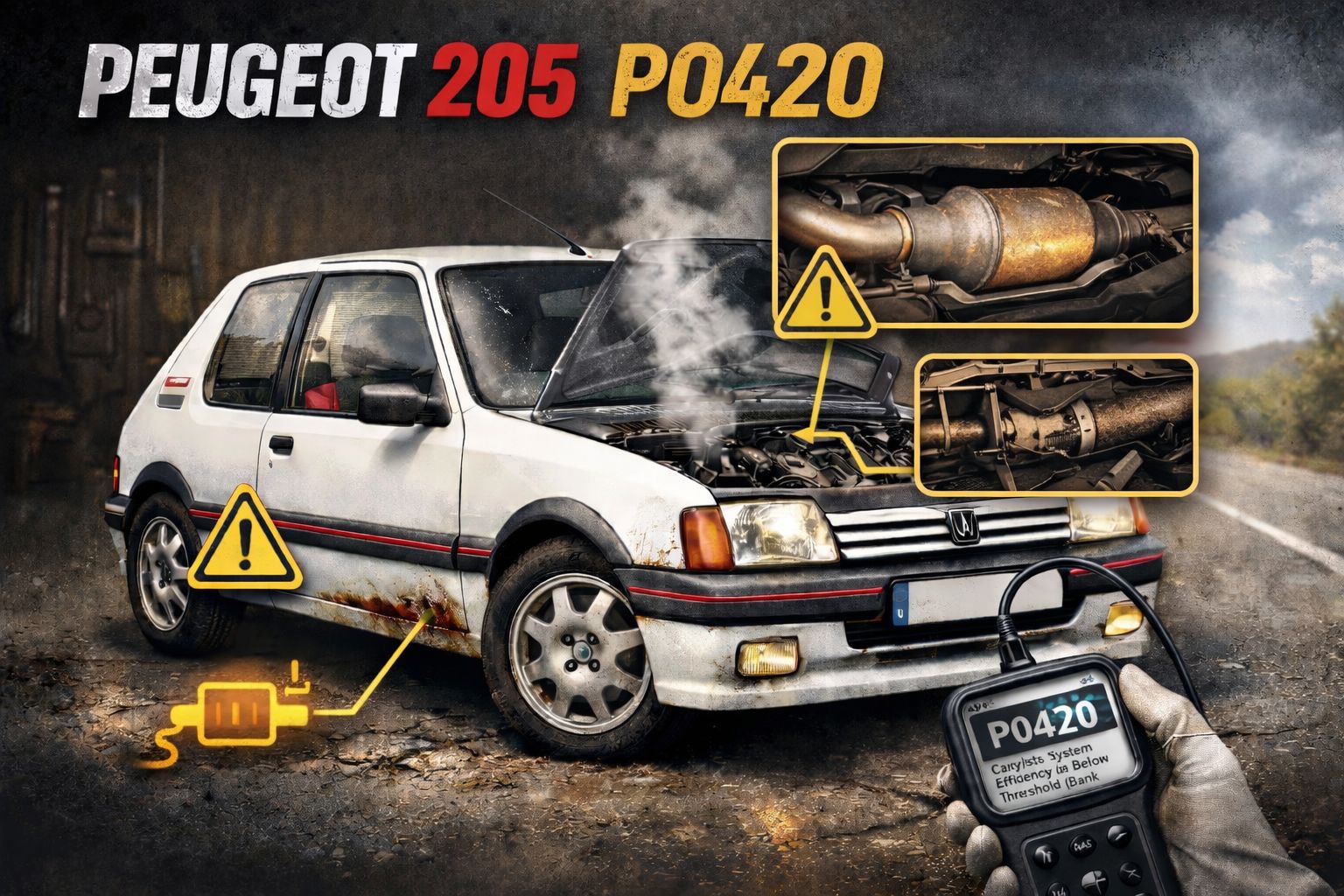
The P0420 code on a Peugeot 205 typically flags up as ‘Catalyst System Efficiency Below Threshold (Bank 1)’. In plain English, the car’s brain reckons the catalytic converter isn’t doing its job as well as it should. However, jumping straight to replacing the cat is often a costly mistake. On these classic French hatchbacks, this code can be a red herring, pointing towards issues elsewhere in the engine’s ecosystem. Think worn lambda sensors, ignition misfires, or fuelling problems that are confusing the system’s readings.
The real sting in the tail with a P0420 is its apparent simplicity. On paper, it screams ‘catalytic converter failure’. But in reality, diagnosing it is far more nuanced. While a knackered cat is certainly a possibility, it could equally be the innocent victim of an engine running too rich, too lean, misfiring repeatedly, or a sensor giving duff information. The key is understanding what the code truly signifies, what symptoms might accompany it, and crucially, the correct order to check things.
What Does P0420 Actually Mean on a 205?
At its core, the P0420 code means the engine control unit (ECU) has decided the catalytic converter’s efficiency has dropped below an acceptable level. The ECU constantly monitors exhaust gas behaviour, often using data from lambda (oxygen) sensors. When the readings suggest the exhaust gases aren’t being treated effectively, the P0420 fault code gets logged.
Crucially, on a Peugeot 205, this doesn’t automatically mean the car is about to grind to a halt. It’s a signal that something is amiss, either with the emissions control system itself or with the engine’s operation that feeds into it. This distinction is vital. A faulty cat can trigger the code, but an engine that’s burning its fuel poorly can just as easily lead to a P0420.
The sensible approach is to view P0420 as an alert about the overall health of the exhaust gas treatment process. From there, you need to work backwards to find the root cause. The catalytic converter might be at the centre of the apparent problem, but it’s not always the source. This makes the P0420 a classic diagnostic minefield.
What Symptoms Might a P0420 Code Cause on a 205?
Sometimes, a P0420 code appears with very few obvious symptoms. The 205 might still drive perfectly fine, without any noticeable juddering or significant power loss. The most common giveaway is simply the ‘check engine’ light illuminating on the dashboard, or a fault appearing when the car is scanned with a diagnostic tool. This subtlety is what makes the code so misleading; it might seem minor while actually revealing a long-standing imbalance.
In other instances, you might notice a dip in performance, a less responsive engine, sluggish acceleration, increased fuel consumption, or even an unusual smell from the exhaust. If the catalytic converter is severely degraded or blocked, it can restrict the engine’s ability to breathe, impacting overall performance. However, this isn’t always the case.
It’s also important to look for associated symptoms. A 205 that’s already suffering from ignition misfires, an unstable idle, hesitation during acceleration, or poor fuelling management is highly likely to throw a P0420 as a consequence of another underlying issue. This is precisely why it’s essential to always consider the P0420 within the broader context of the engine’s recent history and overall behaviour.
Is the Catalytic Converter Always to Blame?
No, and this is the first and most important point to grasp. While the catalytic converter is the component directly flagged by the P0420 code, it’s not automatically the guilty party. Many hasty diagnoses make the mistake of condemning the cat straight away. The converter is replaced, the code reappears, and only then do mechanics realise the actual fault lay elsewhere.
On a 205, a catalytic converter can certainly wear out due to age, high mileage, harsh usage, or repeated exposure to imperfect combustion. However, it can also be damaged by an upstream problem: an engine running excessively rich, persistent ignition misfires, poorly burnt fuel, injection system faults, or incorrect sensor readings. In these scenarios, the catalytic converter isn’t entirely innocent, but it’s not the primary source of the problem.
Before concluding the cat is finished, you must verify the engine has been running correctly over time. A healthy catalytic converter simply cannot cope with constant poor combustion. If the 205 has been driven with engine issues, misfires, or fuelling problems, the P0420 might simply be the final symptom of an older, unresolved issue. It’s crucial to think in terms of cause and effect, not just isolated components.
Can a Lambda Sensor Trigger a P0420?
Yes, a worn or malfunctioning lambda (oxygen) sensor is a very credible cause. If the sensor provides inaccurate or inconsistent data, the ECU can misinterpret the efficiency of the exhaust gas treatment. This can lead to a false P0420 reading, suggesting the catalytic converter is ineffective when, in reality, the sensor’s readings are flawed.
On a 205, the accuracy of engine data is paramount. A tired, slow-reacting, or simply inaccurate lambda sensor can lead to incorrect fuelling adjustments or readings that don’t reflect the true combustion conditions. This is especially true when multiple engine components are showing their age simultaneously: sensors, air intake, ignition system, fuel delivery. The resulting fault code might be P0420, but the real fix could lie further back up the diagnostic chain.
The challenge, as ever, is distinguishing cause from effect. A lambda sensor can disrupt engine management, put undue stress on the emissions control system, or simply mislead the ECU. It absolutely deserves thorough investigation in the diagnostic process, particularly if other engine-related symptoms are already apparent.
Engine Misfires, Fuelling Issues, and Upstream Faults
The P0420 code often forces a mechanic to look further upstream in the engine’s operation. If the 205 is experiencing ignition misfires, running too rich, too lean, or suffering from irregular combustion, the exhaust gases reaching the catalytic converter are not within the expected parameters. Consequently, the emissions control system struggles to function correctly, or its lifespan is significantly shortened.
An engine that misfires sends unburnt or partially burnt fuel into the exhaust system. Over time, this can damage the catalytic converter and lead to reduced efficiency. Similarly, an overly rich mixture overloads the converter, while a lean mixture can also upset the engine’s overall operation and the data the ECU receives. The P0420 can therefore be the final consequence of a pre-existing combustion problem.
On a Peugeot 205, it’s therefore vital to check if there are, or have recently been, any other fault codes or symptoms such as misfires (P0300 series), fuelling issues (rich/lean codes), rough running, or power loss. It’s a mistake to treat a P0420 as an isolated incident. Very often, the only way to truly resolve this code is by first fixing the primary upstream issue.
What Checks Should Be Prioritised?
The first step is always to review the vehicle’s symptom history. Has the car been running rough? Has fuel consumption increased noticeably? Was the idle unstable? Have other fault codes appeared recently? This information is invaluable, as it helps determine whether the P0420 is appearing in isolation or as part of a wider engine imbalance.
Next, assess the overall state of combustion. This includes checking the ignition system (spark plugs, leads, coil pack), the air intake system, the quality of the fuel mixture, and the general health of the exhaust system. If the 205 is already showing signs of irregular operation, it makes sense to address these issues before focusing solely on the catalytic converter.
The exhaust system itself warrants a thorough inspection. Leaks, corrosion, poor sealing, or damaged components can all skew the sensor readings. Finally, only after all other potential causes have been meticulously ruled out does the catalytic converter itself become a more credible suspect. But it should never be the automatic first conclusion.
Can You Drive with a P0420 Code on a 205?
In many situations, yes, a Peugeot 205 can continue to be driven with a P0420 code, particularly if the engine is generally running well and the fault isn’t accompanied by other severe symptoms. This code doesn’t always result in immediate failure or a drastically compromised driving mode. However, that doesn’t mean it should be ignored.
If the P0420 appears alone, without misfires, significant power loss, or genuinely concerning engine behaviour, it’s often possible to continue driving cautiously while you investigate the cause. However, if the fault is accompanied by ignition misfires, a rough-running engine, excessive fuel consumption, strange smells, or a noticeable drop in performance, you should limit usage and address the problem as a matter of urgency.
The key takeaway here is that a P0420 code isn’t always dangerous in itself, but it can be a symptom of a problem that requires prompt attention. Therefore, always consider the vehicle’s overall behaviour before deciding whether it’s safe to continue driving normally.
Common Mistakes to Avoid with a P0420 Code
The most common mistake is immediately replacing the catalytic converter without thoroughly investigating other potential causes. This is the classic trap. If the engine has an underlying ignition, fuelling, or sensor issue, a new catalytic converter might not solve the problem permanently, and it could even be damaged again by the same poor operating conditions.
A second mistake is simply clearing the fault code without identifying and rectifying the cause. While this might temporarily extinguish the warning light, it does nothing to resolve the actual problem if it persists. A third error is to dismiss other engine symptoms because the code appears to relate only to emissions control. On a 205, a P0420 often signals a broader engine imbalance rather than a single component failure.
Finally, avoid overly hasty diagnoses based on a single piece of data. Effective diagnosis requires cross-referencing the fault code with the context of its appearance, the engine’s behaviour, ignition and fuelling status, and the vehicle’s maintenance history. This methodical approach helps prevent unnecessary and costly component replacements.
What Order Should the Diagnosis Follow?
The correct diagnostic procedure involves investigating upstream engine issues before concluding that the catalytic converter is solely responsible. Start by observing all symptoms and checking for any associated fault codes. Next, verify the quality of combustion: examine the ignition system, spark plugs, wiring, engine running characteristics, fuelling, and intake system. Then, check the accuracy and coherence of sensor data and the overall engine management system.
Only after thoroughly ruling out or addressing these potential causes does it become logical to give more serious consideration to the hypothesis of a genuinely worn-out catalytic converter. On a Peugeot 205, adhering to this diagnostic hierarchy is crucial. It prevents confusing the component that signals a problem with the actual root cause of the fault.
In essence, the P0420 code should not be interpreted as an automatic death sentence for the catalytic converter, but rather as an alert regarding the efficiency of the pollution control system and the quality of the combustion feeding it. This comprehensive diagnostic perspective yields the most reliable and cost-effective results.
Key Takeaways on the P0420 Code for the Peugeot 205
The P0420 code on a Peugeot 205 signifies insufficient catalytic converter efficiency, or more broadly, an issue with exhaust gas treatment detected by the engine management system. Yes, the catalytic converter can be involved. But no, it’s not always the sole culprit. A worn lambda sensor, an engine running poorly, ignition misfires, or incorrect fuelling can also trigger or contribute to this fault.
The correct diagnostic approach involves tracing the logical chain: combustion health, ignition, fuelling, intake, sensors, exhaust system integrity, and only then, if all else is consistent, the catalytic converter. This methodical process helps avoid unnecessary parts replacements and ensures the true cause of the problem is addressed.
If you’re looking to delve deeper into diagnosing your 205, it’s also worth consulting dedicated articles on common issues like the P0300 (misfire) code, P0171 (lean mixture) code, general fault reading procedures for this model, and symptoms such as rough running or power loss. It’s by connecting the dots between codes, causes, and symptoms that you’ll achieve the most accurate diagnosis.
Related articles about Peugeot 205
Selection of articles, guides and advice about Peugeot 205.

First-Timers at Le Mans: Unforgettable Debuts at the World’s Greatest Race
Le Mans Firsts: Experiences That Stay With You Forever The 24 Hours of Le Mans is more than…

Diagnosing Power Loss in Your Peugeot 205
A Peugeot 205 that is losing power rarely gives a single clear indication. The engine may feel more…
