Audi’s Milan Design Week appearance is less a product showcase than a statement about how the brand wants to be seen. By centring its presence on “Origin”, an installation created with Zaha Hadid Architects, Audi is using design rather than outright marketing to frame its next phase.
That matters because the cars on display are not there in isolation. The installation, the new design language, the first plug-in hybrid RS 5 and even Audi’s Formula 1 programme are all being presented as parts of the same story: technology filtered through design, and performance recast as a broader cultural proposition.
“Origin” is being used to define Audi’s new design language in public
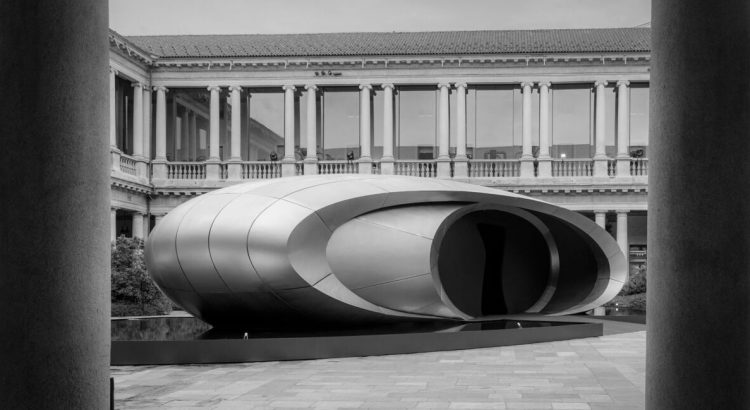
At the centre of Audi’s stand is “Origin”, an installation developed with Zaha Hadid Architects and placed in the courtyard of the former Archiepiscopal Seminary, now the Portrait Hotel on Corso Venezia. Audi describes it as an architectural expression of its current design philosophy: clarity, technicality, intelligence and emotion.
That is more than set dressing. Rather than leading with a launch-stage reveal, Audi is choosing a design event to explain how it wants its products to be read. In practical terms, “Origin” is meant to strip away the unnecessary and focus attention on form, material and atmosphere, which gives a clearer sense of where the brand believes its visual identity is heading.
The installation’s setting matters as much as the object itself
The structure is designed to change through the day, with reflections and shadows altering how it is perceived as visitors move around it. Its matte metallic finish, described as recalling technical materials such as titanium, is intended to pick up and soften the colours of the courtyard rather than dominate the space.
That relationship with its surroundings is important. In a city overloaded with visual stimuli during design week, Audi is deliberately pitching calm as a design value. It is a neat contrast: a contemporary object in a historic Milanese setting, used to argue that advanced design does not need to shout to make its point.
The RS 5 and Audi’s Formula 1 car broaden the message beyond architecture
Alongside the installation, Audi is showing the new RS 5, described as the first high-performance plug-in hybrid from Audi Sport. The company is also displaying the Audi R26 as part of its forthcoming Formula 1 entry.
Those two exhibits give the stand some substance beyond the conceptual language. The RS 5 links electrification to Audi Sport’s road-car line-up, while the Formula 1 project places the brand in a field where efficiency, packaging and performance are inseparable. Audi does not provide technical figures here, so there is no basis for judging outputs or performance claims, but the intent is clear enough: electrified road cars and top-level motorsport are being folded into the same design-led narrative.
Audi is using Milan to talk about mobility as culture, not just transport
This is Audi’s 13th consecutive year at Milan Design Week, and the brand is again framing its presence as part of a wider discussion rather than a straightforward car display. The themes it highlights include sustainability, urban living, material innovation and, for 2026, sensory overload.
That framing tells you quite a lot about the audience Audi is targeting. Milan Design Week is not a motor show, and that is precisely the point. It allows the firm to speak to architects, designers and cultural tastemakers as much as car buyers, positioning mobility as something shaped by society, behaviour and environment rather than engineering alone.
The opportunity is clear, but so is the limit of this approach
There is a logic to all this. Premium brands increasingly need to sell identity as much as hardware, and Audi is hardly alone in using design culture to reinforce that message. Presenting calm, restraint and material sophistication as brand values is a plausible way of distinguishing itself in a crowded premium market.
Still, there is an obvious limit. Design language can frame a car, but it cannot replace the car itself. Without technical detail on the RS 5 or a deeper explanation of how this philosophy will alter production models, much of the argument remains symbolic. Milan gives Audi a stage for the idea; the harder test will be whether future road cars deliver it convincingly.
En résumé
- Audi’s 2026 Milan Design Week presence is built around “Origin”, an installation created with Zaha Hadid Architects.
- The project is intended to express Audi’s current design themes: clarity, technicality, intelligence and emotion.
- The new RS 5 is being presented as Audi Sport’s first high-performance plug-in hybrid.
- Audi is also using the event to highlight its Formula 1 programme via the Audi R26.
- The broader aim is to place mobility within a cultural and design conversation, not merely a product one.
- The unresolved question is how strongly this design-led message will translate into future production cars.