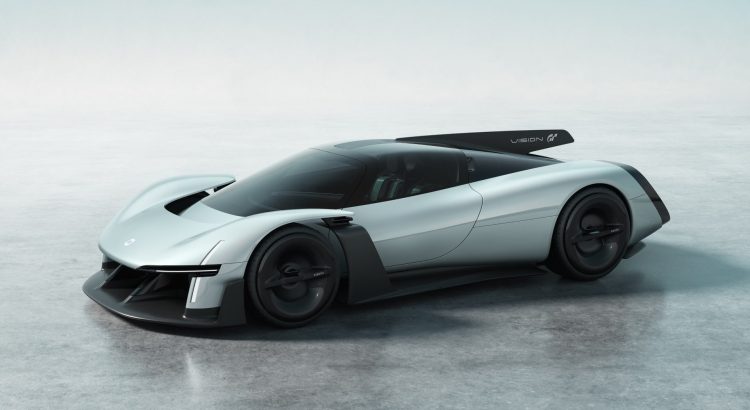
By unveiling the Vision Gran Turismo at MWC in Barcelona, Xiaomi is not merely winking at the video game world. In reality, the Chinese giant appears to be laying the groundwork for a more ambitious industrial strategy, aiming to establish itself in the European electric vehicle market. But behind this stylistic exercise, what is Xiaomi’s true intention?

A First for a Tech Company
The Xiaomi Vision Gran Turismo, recently unveiled at MWC in Barcelona, marks a significant turning point: Xiaomi becomes the first tech company to join the Vision Gran Turismo programme, a circle traditionally reserved for car manufacturers. This invitation from Kazunori Yamauchi, creator of the Gran Turismo franchise, is not insignificant. It comes as Xiaomi has already integrated its first electric cars into the game, the SU7 and YU7, and has international ambitions on the horizon for 2027. In short, Xiaomi is looking to position itself as a serious player in the automotive sector, capable of competing with established brands.

A Virtual Concept for Image Building
The Vision Gran Turismo is not a production model, but a concept designed for a video game. This choice allows Xiaomi’s designers to push the boundaries of creativity without the constraints of homologation or industrial costs. The result is an electric hypercar with impressive specifications: a drag coefficient (Cx) of 0.29 and an aerodynamic efficiency ratio of 4.1. But more than these figures, it is the narrative surrounding this creation that is striking. Slogans like “Sculpted by the Wind” and “Human × Car × Home” illustrate how Xiaomi aims to link its technological ecosystem to the automotive world.
Is Xiaomi Laying the Groundwork?
The choice of Barcelona for the presentation of this Vision Gran Turismo is not incidental. Europe represents a major strategic target for Xiaomi in the electric vehicle arena. While this virtual hypercar does not presage a future road-going supercar, it serves to build an image. By highlighting themes such as aerodynamic mastery and software integration, Xiaomi sends clear signals about its capacity to innovate in a rapidly transforming sector. In a context where the boundary between car manufacturer and tech company is blurring, this approach aims to establish its credibility and expertise.
A Stroke of Genius or a Defensive Maneuver?
This strategic choice raises questions about Xiaomi’s long-term viability in the automotive sector. While traditional players like Volkswagen and Renault are battling to establish themselves in the electric world, Xiaomi is making the bold bet of using the video game realm to attract a younger, tech-savvy audience. This could be seen as a defensive manoeuvre in the face of fierce competition, but also as a stroke of genius to capture the attention of new generations. By integrating advanced technologies within a playful framework, Xiaomi could well transform the perception of what a car is.
A Changing Ecosystem
Xiaomi is not just entering the automotive sector; it aims to redefine what it means to own a car. With the Vision Gran Turismo, the idea of a car becomes that of an extension of our connected daily lives. This concept conveys the notion of an intelligent car, integrated into our home and digital environment. By betting on interconnectivity and artificial intelligence, Xiaomi seeks to stand out in a market where technology is becoming a decisive criterion for consumers.
In Summary
- Xiaomi positions itself as a serious player in the automotive sector with the Vision Gran Turismo.
- The concept is a technological showcase rather than a production model.
- Xiaomi’s European strategy relies on creating a strong and innovative image.
- The link between technology and automotive is reinforced by modern and connected themes.
- Xiaomi could transform the perception of the automobile by integrating elements from the digital world.
In conclusion, the Xiaomi Vision Gran Turismo represents much more than a mere PR stunt. It is a thoughtful attempt to establish itself in a rapidly changing automotive market. Who is this virtual hypercar aimed at? Those who see the future of the automobile as an integrated technological ecosystem. It remains to be seen whether this strategy will bear fruit in the coming years, amid ever-evolving competition.