
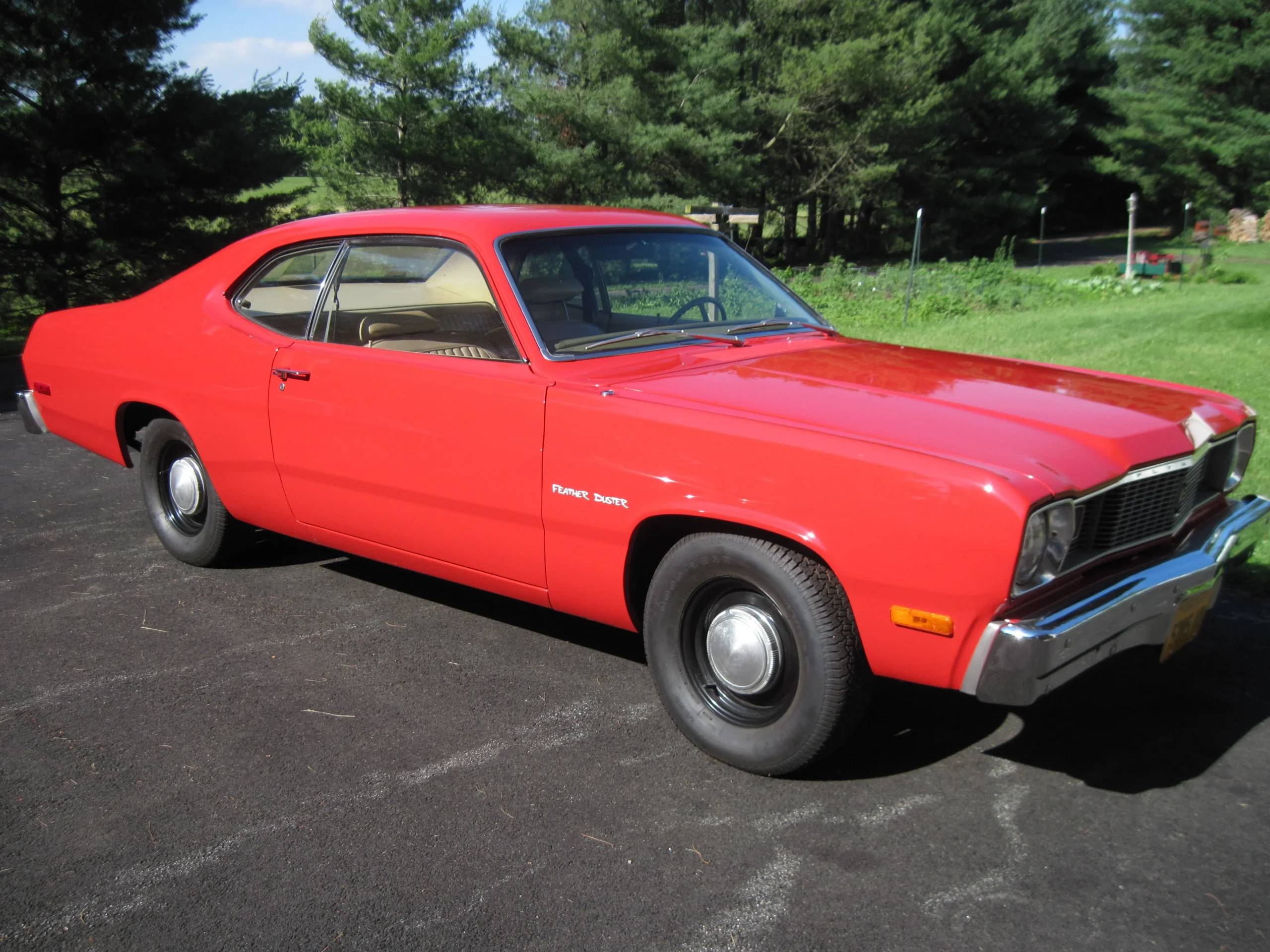
In the 1970s, the automotive industry had to juggle unprecedented challenges. The Plymouth Feather Duster, born from the oil crisis of 1973-1974, embodies this desire for lightness and economy. With its clever enhancements, it became the darling of performance enthusiasts in search of reduced weight. Who would have thought such delicacy could make such a big noise?
An oil context that disrupts habits
The oil crisis of the 70s was a true cataclysm for American motorists, who saw fuel prices soar. In this context, each manufacturer had to find its own strategy to attract consumers increasingly concerned about their consumption. The Plymouth Feather Duster stood out with its radical and ingenious approach. By using aluminum parts to lighten its weight, the Feather Duster managed to reduce its weight by nearly 90 kg compared to the standard model. A true “diet” operation that sparked the interest of speed enthusiasts!
A bold design and a promise of savings
At first glance, the Feather Duster does not differ much from its sister, the classic Duster. However, appearances can be deceiving: under the hood lies a clever engineering. In 1976, Plymouth offered a “Fuel Economy Package” for $50.56 that transformed any Duster into a Feather Duster. This package included a very high axle ratio of 2.94:1, a specific exhaust, and a recalibration of the single-barrel carburetor. All this aimed to achieve a consumption of 9.8 L/100 km in the city and 6.4 L/100 km on the highway. For the time, this was a commendable performance!
A quest for weight reduction
Every gram counts when it comes to optimizing fuel consumption. Thus, the Feather Duster swapped its traditional body for aluminum elements for the hood, the interior structure of the trunk, the bumper supports, and even the transmission case. The result? A loss of 85 kg on a car that already weighed less than 1,400 kg. This reminds you of an old cooking recipe where every ingredient matters to achieve a tasty dish: here, every piece was carefully chosen to maximize efficiency.
Transmission and performance
To accompany this quest for efficiency, the Feather Duster was offered with a four-speed manual gearbox including an overdrive ratio or a three-speed automatic transmission. Although acceleration slightly suffered from these modifications, Plymouth announced figures that whetted the appetite: 24 mpg in the city and 36 mpg on the highway. Not bad for a vehicle of this size! Of course, these figures may seem trivial today against modern standards, but for the time, they were a benchmark.
A model cherished by V8 enthusiasts
Ironically, despite its economy qualities, the Feather Duster also became a favorite among performance enthusiasts. Its reduced weight attracted drivers looking to maximize their speed on the track. Many of them were modified to accommodate powerful V8 engines. This model thus became a rare gem among modified cars, making original examples almost mythical. Only about 5,800 Feather Dusters were produced, and today, their numbers continue to dwindle.
A solution too late?
Unfortunately for Plymouth, the Feather Duster arrived too late in the automotive landscape. As the oil crisis began to stabilize in 1976, consumers were already eyeing smaller, more economical Japanese models. The Feather Duster and its twin, the Dodge Dart Lite, became relics of a bygone era where every gram and every litre counted.
Final thoughts on an iconic model
In summary, the Plymouth Feather Duster is more than just a car; it is a symbol of a pivotal time in American automotive history. If you are passionate about cars and wish to explore this fascinating world further, the passion for classic cars awaits you. This particular model remains a curiosity that reminds us how engineering can bend to market constraints while attempting to bring a touch of performance.


