

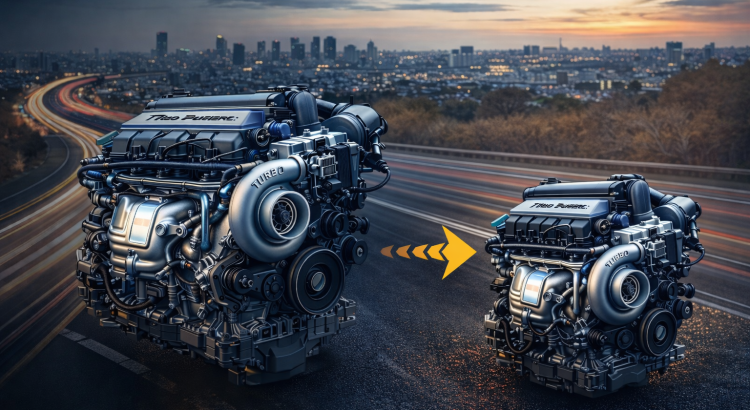
Since the early 2010s, compact engines have become an important technical solution to address environmental and regulatory pressures in the automotive industry. The reduction in engine displacement, the proliferation of turbochargers, and the promise of reducing fuel consumption and CO2 emissions while providing comparable performance: theoretically, the compact engine seems to be the ideal solution.
However, over time and through drivers’ experiences, this engine strategy raises many questions today. Real fuel consumption, reliability, driving pleasure, adaptation to heavy vehicles… Compact engines are both fascinating and controversial. This article offers a comprehensive, objective, and in-depth analysis to understand what compact engines really are, why they are widely used, and what their limitations and future prospects are.
What are Compact Engines in the Automotive Industry?
Compact engines refer to the reduction of combustion engine displacement while maintaining comparable performance to larger engines. This reduction is made possible by technologies such as turbochargers, high-pressure direct injection, advanced electronic management, and optimisation of thermal efficiency.
More specifically, a classic atmospheric engine of 2.0 litres is replaced by a turbocharged engine of 1.2 or 1.3 litres, which displays comparable or even superior performance in technical parameters.
👉 To understand in detail the technical principles of compact engines: Compact Engines: Simple Definition and Explanation of Their Operation
Why Do Manufacturers Opt for Compact Engines on a Large Scale?
Compact engines are not an isolated choice but the direct result of several factors:
- Increasingly strict European emission standards (Euro 5, Euro 6, then Euro 7),
- Control of CO2 emissions as a tax criterion in many countries,
- Historically favourable certification cycles for compact engines (NEDC then WLTP),
- Strong competitive pressure to publish fuel consumption data.
In this context, compact engines have become an almost indispensable industrial solution, sometimes pushed to its limits.
👉 A comprehensive analysis of this strategy: Why Manufacturers Generally Use Compact Engines
Theoretical Advantages of Compact Engines
From a theoretical and regulatory standpoint, compact engines offer several undeniable advantages:
- Reduced fuel consumption during certification tests,
- Lower CO2 emissions, reducing ecological penalties,
- The engine is more compact and lighter,
- Thanks to the turbocharger, torque is generally available earlier.
These advantages make compact engines particularly suitable for moderate and cautious driving, especially in urban and suburban environments.
Compact Engines and Real Fuel Consumption: Frequent Discrepancies
In practice, many drivers find that published fuel consumption differs from real fuel consumption. Due to frequent use, compact engines often operate under high load, which can negate theoretical advantages.
On motorways, in mountainous areas, or during hard accelerations, the fuel consumption of small turbocharged engines can be comparable to or even higher than that of larger engines.
👉 Detailed analysis: Compact Engines and Real Fuel Consumption: Why There Are Differences with Official Data
Reliability of Compact Engines: What You Really Need to Know
Compact engines subject the mechanical structure to significant stresses: high pressure in the cylinder, high temperatures, heavy loads on the turbocharger. Not all compact engines respond the same way under these stresses.
The reliability of compact engines largely depends on the following factors:
- Their initial design,
- Adherence to maintenance intervals,
- Driving style,
- The vehicle in which the engine is installed.
👉 In-depth analysis: Compact Engines and Reliability: What You Really Need to Know
Compact Engines in Daily Life: What Applications Are They Suitable For?
In urban traffic or for short trips, compact engines can deliver excellent results and provide enjoyment. However, during long journeys, heavy loads, or towing, their limitations become apparent more quickly.
👉 Application after analysis: Compact Engines in Daily Life: City, Motorway, Loading, and Long Trips
Compact Engines and SUVs: A Complex Equation
The combination of compact engines with heavy and aerodynamically unfavourable SUVs actually leads to consistency issues. In this case, the engines often operate under high load, which increases fuel consumption and wear, and can sometimes lead to noise nuisances.
👉 Technical report: Compact Engines and SUVs: Is It Really a Suitable Propulsion System?
Compact Petrol Engines and Compact Diesel Engines: Two Different Logics
Compact engines are used differently for petrol and diesel engines. Thermal stress, low-end performance, and durability vary depending on the type of fuel.
👉 Detailed comparison: Compact Petrol Engines and Compact Diesel Engines: What Are the Differences in Application?
Maintenance of Compact Engines: Important Points
Compared to conventional engines, compact engines require rigorous maintenance: high-quality fuel, adherence to warm-up times, appropriate driving after heavy loads.
👉 Mistakes to Avoid: Maintenance of Compact Engines: Mistakes to Avoid
From Compact Engines to Appropriate Engines: A Return to Balance
In the face of the exaggeration of compact engines, some manufacturers are beginning to return to appropriate engines, representing a more balanced approach aimed at adapting displacement to the vehicle and its actual use.
👉 Analysis of this evolution: From Compact Engines to Appropriate Engines: A Return to a More Rational Engine
Compact Engines and Hybrid Systems: Logical Transitions
Light or full hybrid systems can compensate for some weaknesses of compact engines, particularly at low revs or under heavy load. In this case, the compact engine becomes more relevant.
👉 Interpretation: Compact Engines and Hybrid Systems: Sustainable Solution or Simple Transition Phase?
Is Buying a Car with a Compact Engine a Good Choice?
Compact engines are neither a scam nor a one-size-fits-all solution. If well chosen and suited to the use, they can make sense. Otherwise, incorrect sizing can lead to frustration and higher maintenance costs.
👉 Tips Before Buying: Buying a Car with a Compact Engine: Is It a Good or Bad Choice Today?
Conclusion: Compact Engines, Transition Solutions
Compact engines allow manufacturers to respond quickly to environmental pressures. However, their limitations are now clearly recognised. Compact engines are not just a goal but are seen as a transitional solution that will evolve towards more rational and increasingly electrified propulsion systems.


