

MotoGP is poised for a significant overhaul from 2027. As contracts between teams, manufacturers, and the organiser are renegotiated for the 2027-2031 cycle, a bold proposal is on the table: limiting riders to a single motorcycle during races. If adopted, this measure would dramatically alter team strategies and finances in a bid to control expenditure.
Manufacturers propose a lighter bill
Behind the scenes in the world of MotoGP, where discussions about future technical and contractual regulations are in full swing, an idea has surfaced: allowing just one bike per rider in the premier class, instead of the current possibility of running two. This proposal, coming directly from the manufacturers, has a clear objective: to reduce teams’ operating costs. The argument is straightforward: fewer bikes to prepare and transport could mean less dedicated technical staff, leading to substantial savings. However, the precise amount of these savings remains unclear and is a subject of debate.
Will MotoGP take inspiration from WorldSBK?
Should this measure be voted through and approved by the Grand Prix Commission, MotoGP would adopt a system similar to that already in place in the Superbike World Championship (WorldSBK). In that series, each rider has a primary bike, but a second machine is available in reserve in the pit box. In the event of a serious crash damaging the first bike (the chassis, for example), the team can request permission from officials to field the replacement bike. MotoGP could potentially follow this model, permitting a reserve bike but under strict conditions for its use.
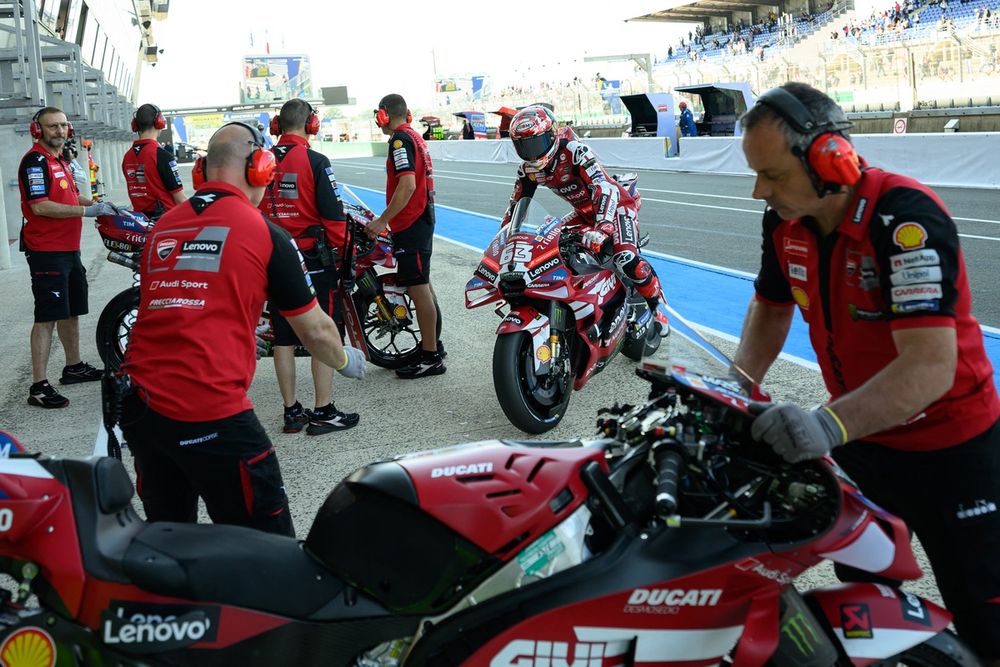
No more parallel set-ups for wet and dry conditions.
Race strategies turned upside down
The most immediate impact of this potential new rule would concern team strategy. Currently, having two bikes allows engineers to test and compare different configurations, or even to specifically prepare one machine for dry conditions and another for the wet. This capability to have two bikes with distinct set-ups, ready for use, is particularly valuable during weekends with uncertain weather. Limiting teams to a single bike would force them to make more decisive choices in advance.
The end of the spectacular ‘flag-to-flag’?
Another major consequence is that the famous ‘flag-to-flag’ procedure, a spectacular and dynamic process allowing riders to change bikes during a race if weather conditions change, could disappear in its current form. For about twenty years, riders have taken advantage of these changes to jump onto their second machine, already set up for the new conditions. If MotoGP were to align with WorldSBK, pit stops for bike changes would become longer and more regulated, with mechanics needing to carry out modifications (particularly switching between wet and dry tyres) within a set time to ensure safety. This would be a slower transition, thus less conducive to last-minute changes.
A notable shift for motorcycle racing’s elite
In summary, the move to one bike per rider in MotoGP, if it materialises, would represent far more than a simple technical modification. It would be a revamp of strategies, an optimisation of resources, and potentially an evolution of the spectacle offered to fans. Manufacturers are pushing for cost control, teams will have to adapt to new operational constraints, and riders might see their ability to react to race uncertainties altered. The future of MotoGP from 2027 onwards is already shaping up to be rich in debate.
- Objective: Reduce teams’ operational costs.
- Inspiration: The current World Superbike (WorldSBK) model.
- Strategic consequences: Less flexibility for testing different set-ups.
- Impact on the spectacle: Potential disappearance of dynamic ‘flag-to-flag’ changes.
- Procedure: Requires a vote and approval from the Grand Prix Commission.
- Timeline: The decision is expected for the 2027-2031 cycle.


