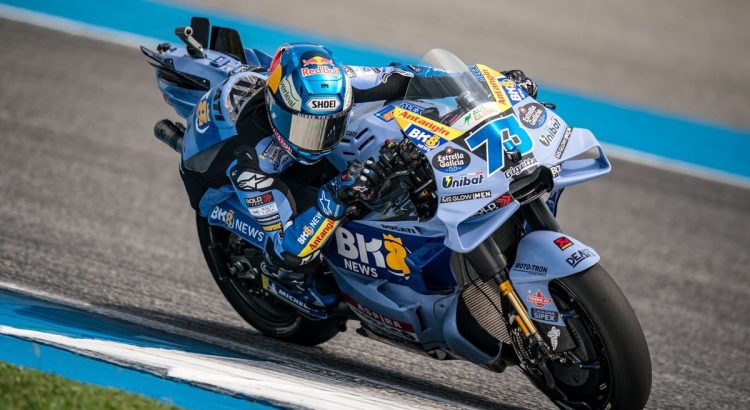
At the Thai Grand Prix, Álex Márquez‘s situation with his Ducati revealed a worrying weakness within a team that had seemed on the right track. Last year, he shone as a key rival to his brother, but this season he faces technical challenges that could redefine his future in MotoGP.
A Tough Weekend for Ducati
The race in Buriram was a real eye-opener regarding Ducati’s shortcomings, particularly for Álex Márquez. While his brother Marc valiantly battled against the riders from Aprilia and KTM, the Gresini rider struggled to find the right balance on his machine. This observation is all the more concerning as he is now riding the latest model, the GP24, which is supposed to deliver optimal performance. Yet, the positive sensations seem to be fading.
Indeed, Márquez expressed his concerns about the behaviour of his machine, which he described as “strange”. This feeling of losing reference points is even more pronounced when comparing his situation to last year. Back then, he knew how to exploit grip and speed when cornering. Today, those elements seem to have vanished, raising questions about Ducati’s technical decisions.
Reasons for a Lack of Confidence
In his statements, Márquez highlighted a recurring issue: his inability to feel the front end of his machine. This lack of feedback directly impacts his ability to navigate corners, a crucial aspect in MotoGP. He mentioned adjustments to his machine to address this situation, but the road ahead seems long before he regains a satisfactory level of confidence.
The concrete consequences of this instability could have catastrophic effects on his career. A rider unable to adapt to their machine is at risk, especially in such a competitive discipline as MotoGP. Álex Márquez’s performances will therefore be closely monitored in the upcoming races, and a series of mixed results could jeopardise his future at Ducati.
Comparison with Pecco Bagnaia

It is interesting to note that Álex Márquez’s difficulties are not isolated. His teammate, Pecco Bagnaia, has also raised similar concerns regarding confidence in the front end of his Ducati. Last year, Bagnaia faced misfortune in races, and his recent comments suggest he has not fully resolved these issues.
This situation raises a crucial question: Has Ducati become too demanding for its riders? If Bagnaia and Márquez are experiencing similar difficulties, it could indicate that the brand needs to reassess its technical priorities. The pursuit of absolute performance can sometimes lead to compromises that undermine the stability and predictability of the machine.
Implications for Ducati
For Ducati, these revelations are alarming. The Italian brand has built its reputation on innovation and performance, but if its riders cannot unlock the full potential of their machines, it could lead to a crisis of confidence within the team. Race results are critical, not just for statistics but also for the brand’s image.
As competition with brands like KTM and Aprilia intensifies, Ducati must respond swiftly. The current situation could force the team to rethink its technical and strategic decisions to ensure its riders can compete at the highest level.
An Uncertain Future
The real challenge for Álex Márquez is whether he can quickly find solutions to his problems. The pressure is high, both on him and on Ducati. If results do not improve in the upcoming races, he could find himself in a precarious position within the team. Rumours of transfers or rider changes may then increase.
In summary, Álex Márquez’s future in MotoGP will depend not only on his ability to adapt to his machine but also on the strategic decisions Ducati makes. The brand must deftly juggle innovation and performance to ensure its riders can realise their full potential.
Summary
- Álex Márquez is struggling with the Ducati GP24.
- The lack of front-end feedback is affecting his performance.
- Pecco Bagnaia is facing similar issues, raising questions about the machine.
- Ducati must act quickly in light of increasing competition.
- Álex Márquez’s future in the team could be at risk if results do not improve.