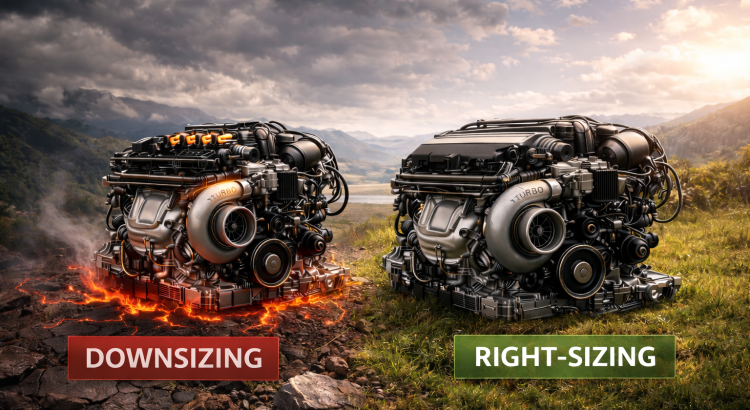
For over a decade, engine downsizing has dominated the strategies of car manufacturers. Reducing engine displacement to achieve better fuel consumption and emissions performance has become the norm. However, after years of experience, a new approach is emerging: right-sizing.
More balanced, more realistic, and better suited to actual use, this philosophy marks a turning point in the design of modern engines.
Why downsizing has reached its limits
Although downsizing has allowed for a quick response to regulatory requirements, it has also revealed several limitations:
- significant differences between official and real-world fuel consumption,
- high mechanical loads,
- a degradation of driving comfort in certain vehicles.
These limitations are particularly visible in heavy or intensively used vehicles.
👉 For a comprehensive analysis:
Downsizing and real fuel consumption: why the difference with official data
What is engine right-sizing?
Right-sizing involves adapting engine displacement and power to the vehicle and its actual use, rather than systematically reducing engine size.
The goal is no longer to achieve the smallest possible engine, but the most coherent engine.
Right-sizing vs downsizing: difference in philosophy
While downsizing aimed to maximise the efficiency of a small engine, right-sizing aims for:
- lower engine load in daily use,
- more stable fuel consumption,
- better mechanical durability,
- more consistent driving comfort.
This approach helps to reduce the constant load on the turbocharger and internal components.
👉 To understand the limits of downsizing:
Engine downsizing: simple definition and explanation of how it works
Why manufacturers are gradually changing course
Several factors explain this return to better-sized engines:
- customer feedback on real fuel consumption,
- long-term reliability concerns,
- evolving homologation standards,
- the emergence of hybridisation.
Right-sizing integrates more easily into a hybrid or electric architecture.
👉 On this topic:
Downsizing and hybridisation: sustainable solution or simple transition?
Right-sizing and real-world use: a better compromise
A right-sized engine operates more often within its optimal performance zone. The result:
- fewer peaks in fuel consumption,
- less thermal stress,
- more consistent behaviour in daily use.
👉 Analysis by type of use:
Downsized engine in daily use: city, motorway, load and long journeys
Right-sizing in SUVs and heavy vehicles
In SUVs, right-sizing often seems a more logical response than pure downsizing. A slightly larger, but less stressed engine can offer:
- more stable fuel consumption,
- better towing capacity,
- greater reliability.
👉 Specific analysis:
Downsizing and SUVs: is the transmission really suitable?
Right-sizing and long-term reliability
By limiting excessive loads, right-sizing naturally improves mechanical durability. Components such as the turbocharger, timing system, or cooling system are less stressed.
👉 Also read:
Downsized engine and reliability: what you really need to know
Does right-sizing mean the end of downsizing?
Downsizing does not disappear completely, but becomes more moderate. Right-sizing represents a pragmatic evolution, better suited to real applications and driver expectations.
Summary
The shift from downsizing to right-sizing illustrates the automotive industry’s growing awareness. After relentlessly seeking to reduce displacement, manufacturers are returning to more coherent and durable engines, better suited to real-world conditions.