

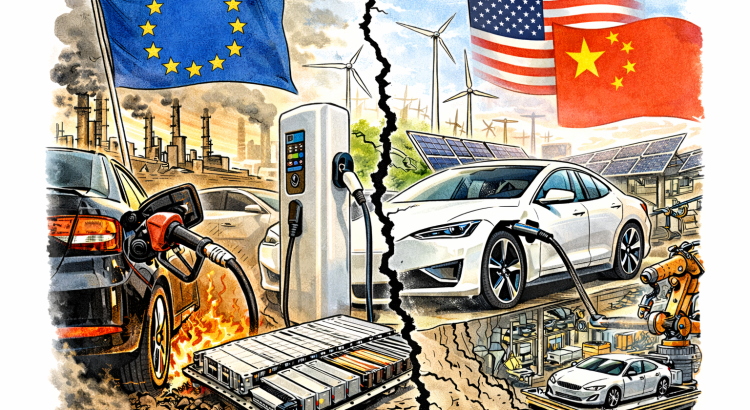
In 2023, the European Union voted to ban the sale of new internal combustion engine cars starting in 2035. Presented as a major ecological turning point, this decision was meant to accelerate the transition to 100% electric.
Two years later, the question has changed. It is no longer: “Should we move away from internal combustion?” But rather: “Has Europe underestimated the industrial, economic, and geopolitical consequences of its decision?”
While Brussels sets dates, the rest of the world is moving forward… differently.
Europe: Ecological Conviction or Risky Industrial Bet?

The European Union has made a clear choice: to move away from internal combustion engines. But this choice is based on several fragile assumptions:
- A massive and rapid adoption of electric vehicles.
- A continuous decrease in battery costs.
- A sufficient industrial independence from China.
- A smooth social acceptance.
However, recent facts show cracks: electric vehicle sales are slowing in several European countries, public subsidies are changing, and several manufacturers are revising their timelines.
The problem is not technological. It is structural. Europe does not control strategic raw materials (lithium, cobalt, rare earths), nor the majority of global battery production.
In other words: the EU has decided to abandon a technology it mastered (internal combustion) to accelerate towards a technology whose value chain it does not yet fully control (batteries, refining, critical metals, cell production).
China: Industrial Pragmatism Over Ideology
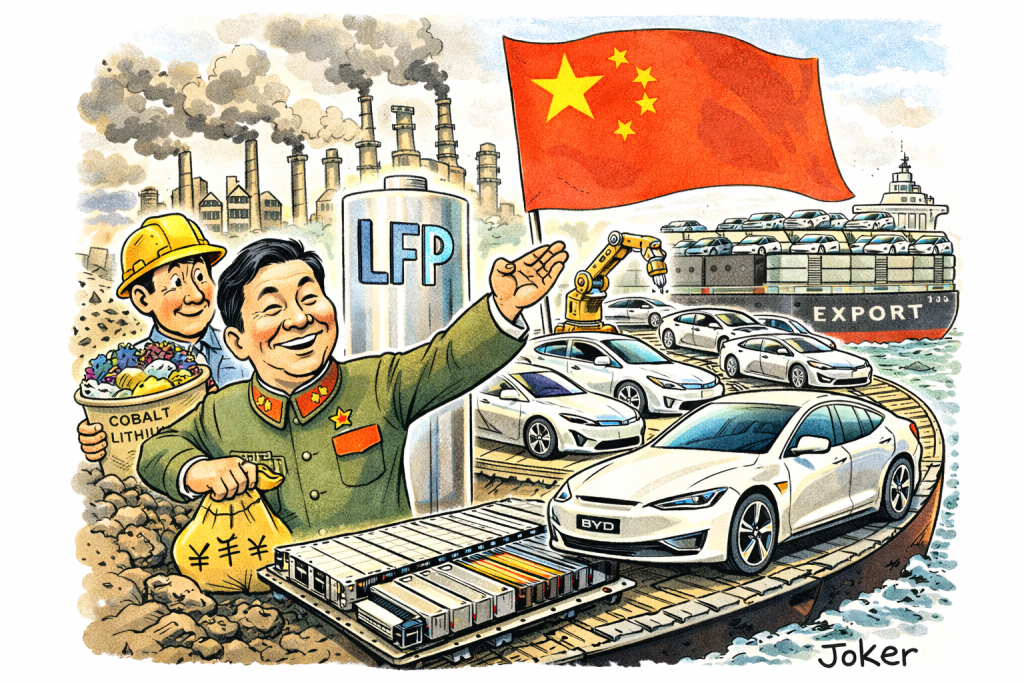
While Europe debates climate ideology, China is moving methodically. Groups like BYD are gaining ground, and mass-produced LFP batteries now dominate part of the market.
Moreover, Beijing has never presented electric vehicles as a moral ban on internal combustion. It is an industrial domination tool:
- Massive subsidies and support for the sector.
- Securing supplies of metals.
- Gigantic production capacity.
- Aggressive export strategy on prices.
As a result, European manufacturers find themselves facing cheaper, technologically advanced Chinese models produced at scale.
The United States: Strategic Flexibility

In the United States, the strategy is different: the administration encourages electric vehicles through tax incentives while avoiding (so far) a rigid federal ban comparable to that of Europe.
Internal combustion pickups remain dominant, hybrids are progressing strongly, and manufacturers are adjusting their ranges according to actual market demand. Washington supports innovation and protects its industry through targeted industrial policies but maintains a margin of maneuver.
Disturbing Numbers
Since 2024:
- Several manufacturers have lowered their 100% electric targets.
- Hybrids are experiencing more dynamic growth than pure electric vehicles.
- Dedicated battery factories are operating below planned capacities.
- Public subsidies are decreasing in some countries.
Electric vehicles are still progressing, but less quickly than expected… and often more expensively than anticipated.
The average European buyer faces three realities:
- High purchase price for comparable equipment.
- Uncertain residual value in the used market.
- Uneven charging infrastructure depending on regions and uses.
The risk? A gradual social rejection, not against ecology, but against a transition perceived as imposed and unbalanced.
Ecological Transition… or Social Shock?
The car is not a luxury product: it is a daily tool for millions of households. By imposing a rigid timeline, Europe is taking a major political risk: transforming a climate ambition into a social fracture.
Wealthy urban classes adapt more easily. Rural and peri-urban areas do not. Yet these areas often depend most on cars for work, travel, and living.
The Blind Spot: Global Carbon Footprint
Another sensitive topic: the complete life cycle. Battery production is energy-intensive. Mass recycling is not yet fully industrialized everywhere. The real carbon footprint of an electric vehicle also depends on the energy mix.
Electric vehicles reduce local emissions. But their overall balance heavily depends on how electricity is produced and the ability to organize an effective large-scale recycling chain.
The transition is therefore more complex than a simple thermal → electric replacement.
Three Scenarios for 2035
1) Strict Adherence to the Timeline
Europe assumes its bet, massively strengthens its battery industry, and accepts a period of turbulence (costs, competitive pressure, social tensions).
2) Strategic Flexibility
Partial extension via hybrids, synthetic fuels, or temporary exceptions. Gradual adaptation based on the market.
3) Official Delay
Faced with economic, industrial, and social realities, a delay becomes politically inevitable.
Today, no scenario is excluded.
The Real Question
The debate should not pit ecology against industry. It should pose a deeper question:
Can we succeed in a technological revolution without mastering the industrial tools of that revolution?
Europe has made a courageous decision. But a courageous decision is not automatically a strategic decision.
2035 is approaching. And the automotive world is already reshaping its balances, between Chinese industrial power, American flexibility, and the European bet on a legally locked transition.
The question is no longer whether internal combustion will disappear one day. The question is at what cost, and who will control the future of the automobile.

