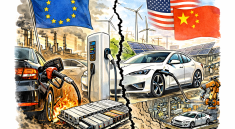
We are sold electric vehicles as an “inevitable” transition… and already profitable. On stage, executives promise margin parity with internal combustion engines. In press releases, they talk about economies of scale, dedicated platforms, cheaper batteries, and a future “cash machine”.
But when we look at the public figures (margins, EBIT by division, profits, and cash flow), a reality emerges: the profitability of electric vehicles is very uneven among manufacturers… and sometimes still largely subsidised, compensated, or buried in aggregates that mask the truth by model.
What “profitable” often means… in the mouth of a manufacturer
Before pulling out the red cards, an essential point: manufacturers can talk about “profitability” without meaning the same thing.
- Gross margin: what remains after the cost of production (COGS). Useful, but does not account for R&D, marketing, factories, etc.
- EBIT / Operating income: closer to industrial reality (includes part of fixed costs), but depends on reporting rules.
- “Mature” profitability: translation: “when we sell much more, later”.
- “Group” profitability: a mix of internal combustion + hybrid + electric. Perfect for smoothing EV losses.
So no: when a manufacturer says “electric becomes profitable,” it does not necessarily mean “every EV sold makes money.”
The figures that sting (by manufacturer)
🇺🇸 Ford: the most brutal proof… because Ford details
Ford has rare transparency: it isolates a dedicated EV division, Ford Model e. And here, we are not in storytelling.
- Ford Model e EBIT loss 2024: -5.076 billion $
- Model e EBIT margin 2024: -131.8% (yes, a negative three-digit margin)
- Model e revenue 2024: 3.9 billion $
Unfiltered Translation: Ford is still “buying” its place in electric vehicles, burning EV cash while its other activities (notably commercial/pro) finance the transition.
⚡ Tesla: profitable, yes… but margins have eroded
Tesla remains the flagship example of a profitable EV player at scale. But the “crazy margins” period has calmed down. Price cuts and ramp-ups (including Cybertruck) weigh heavily.
- Total automotive gross margin (2024): 18.4% (vs 19.4% in 2023; 28.5% in 2022)
- Total automotive gross profit (2024): 14.197 billion $
Translation: Tesla knows how to make money with EVs, but competition and the price war have lowered profitability. And it reminds us of one thing: even Tesla is not immune.
🇨🇳 BYD: the industrial machine winning in volume… and margin
BYD has not built a “moralising” narrative about EVs: it has built an industry. And the 2024 figures show massive economic power.
- Gross margin “automotive & related products”: 22.3% (2024)
- Annual profit: 40.3 billion CNY (record, up year-on-year)
- Sales: 4.25 million vehicles (2024)
Unfiltered Translation: BYD does not need Europe to “believe” in electric vehicles. BYD needs Europe to buy it. And its advantage is integration (batteries, components, volume, price).
🇪🇺 Volkswagen Group: solid… but margins under pressure (transition + China + costs)
Volkswagen gives a “group” view. This does not say whether each EV is profitable, but it shows the overall health during the transition.
- Operating Result FY2024: 19.1 billion €
- Operating Margin FY2024: 5.9%
Translation: VW remains a profitable ship… but not a “comfortable” ship. The margin is not huge for a group that must finance: EV + software + factories + Chinese pressure.
🇪🇺 Stellantis: profitability still present… but significantly degraded
Stellantis has long been the margin machine of the sector. The 2024 results show a sharp decline, with profitability still positive but less “dominant”.
- Net profit 2024: 5.5 billion € (sharply down)
- Adjusted Operating Income (AOI) 2024: 8.6 billion €
- AOI margin 2024: 5.5%
Translation: it is not “electric” alone that explains everything. But it proves one thing: the promise “transition = easy margins” is false. Even the best suffer during the transition phase.
🇩🇪 Mercedes-Benz: premium margin… but EV requires heavy investments
Mercedes remains a premium group with strong historical margins. In 2024, “Cars” profitability declines, while maintaining a high margin for the auto industry.
- Adjusted EBIT Mercedes-Benz Cars (2024): 8.7 billion €
- Adjusted RoS (Cars) 2024: 8.1% (vs 12.6% in 2023)
Unfiltered Translation: the premium protects… but does not cancel transformation costs (R&D, platforms, software). And when China coughs, the premium can bleed.
Quick comparison (note: different metrics)
| Manufacturer | Key public indicator | What it tells us |
|---|---|---|
| Ford | Model e EBIT 2024: -5.076 B$ | EV still very loss-making (transition financed elsewhere) |
| Tesla | Gross margin auto 2024: 18.4% | Profitable, but margins under pressure (price + competition) |
| BYD | Gross margin auto & related 2024: 22.3% | Industrial/volume advantage, integration, price competitiveness |
| Volkswagen Group | Operating margin 2024: 5.9% | Profitable group, but costly transition and pressure from China |
| Stellantis | AOI margin 2024: 5.5% | Profitability declining: product + market + stock transition |
| Mercedes-Benz | Cars RoS 2024: 8.1% | Premium protects, but transformation eats into margin |
Note: comparing indicators of different nature (gross margin vs EBIT vs operating margin) is not perfect. But the order of magnitude is useful: some are already winning with EVs, others are still paying dearly for the transition.
So… are they lying?
The word is harsh. But there is a disturbing truth:
- Many manufacturers communicate about “profitability” by talking about the future, eventual parity, or group margin.
- Few provide profitability by model.
- When a group gives an isolated EV figure (Ford), we see that the bill is still steep.
This is not necessarily a lie: it is a narrative strategy. Because in a transition, trust (market, investors, states, customers) is a weapon.
Unfiltered Conclusion
Electric will become profitable for the majority of groups… but not “magically”. Profitability depends on three things:
- Volume (economies of scale)
- Battery cost (chemistry, sourcing, integration)
- Price war (and thus China)
And this is where the hypocrisy of the debate appears: we talk about “ecology,” but the battle is mainly about margin, industry, and sovereignty.
The real question is not: “Does electric work?”
The real question is: “Who will make money with it… and who will pay the bill?”
— JOKER