


In the relentless world of Formula 1, where every millisecond counts, teams are busy perfecting their cars using increasingly sophisticated simulation tools. As the track eagerly awaited the first evolutions of the 2026 cars, these simulators have become essential for optimising performance without even stepping onto the road.
From Limited Testing to Infinite Simulations
Last week marked a turning point for Formula 1 teams, finally ready to test their cars under the new 2026 regulations. While some teams had already conducted shakedown tests or promotional filming, these tests were often limited in mileage and primarily served to verify the correct functioning of the cars. The reality of the track, on the other hand, allowed for concrete work to begin, often backed by imposing measurement tools. But these tests represent only a part of the process; teams also rely on advanced simulations to prepare for their races.
In the early 2000s, private testing was common, with independent teams constantly running. However, since 2009, testing has been strictly regulated to reduce costs, pushing teams to innovate. Computer simulations have thus taken over, complementing wind tunnel work with computational fluid dynamics (CFD). These simulations allow engineers to anticipate the car’s behaviour without having to go out on the track.
From Simulators to Test Benches: The Transition to Reality
Teams have ultra-modern simulators, often represented by a “dummy” car mounted on supports and surrounded by screens, which replicate the behaviour of a new feature or a change in setup. Once the car is nearly ready, it can be placed on a full-scale test bench capable of simulating all the stresses encountered on the circuit.
Williams, for example, refers to this tool as the “Virtual Test Track.” This device has become crucial for the team, particularly due to their inability to travel to Barcelona. James Vowles, the team principal, may have exaggerated by claiming that running in Barcelona would have no “interest” compared to this test bench, but it remains undeniable that the tools used are very comprehensive.
Vowles specified: “There is the essential physical car. The wings are not mounted, but we have the chassis, the engine, the gearbox. By using robots, we test the brake systems at the same time, so all the brakes are mounted.”
“We define the cooling system, understand where it is, run the engine, the gearbox, etc., under different loads. Together with what is happening in Barcelona, we can use the base codes they have in the power unit and the gearbox to understand the effects, but in a more controlled environment than theirs.”
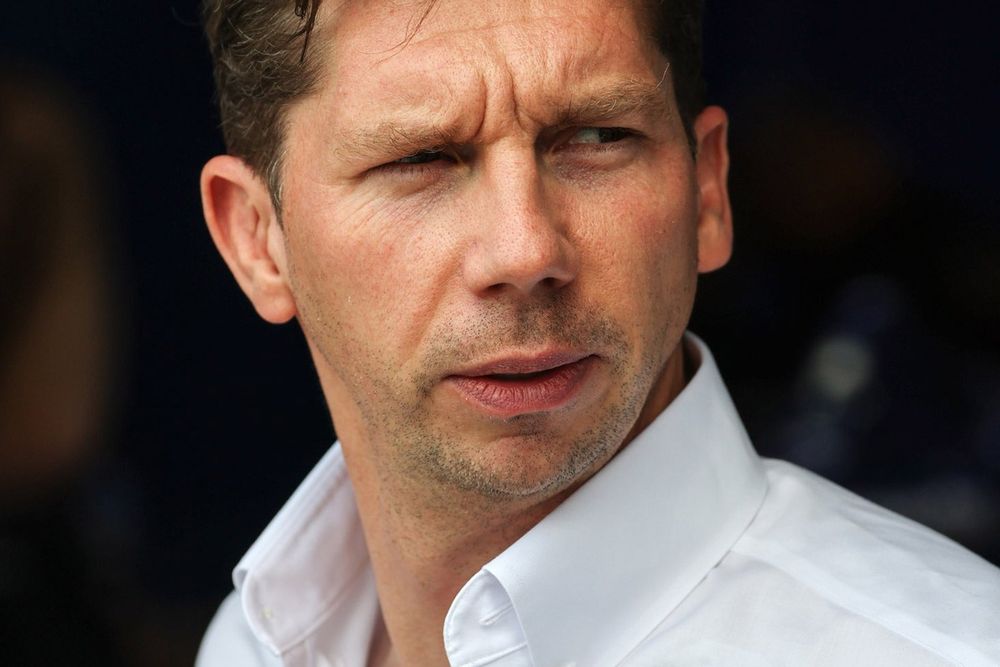
James Vowles, Williams
The Crucial Role of Observation
In addition to simulations, teams do not hesitate to use more traditional means to correlate the reliability of their tools: the camera. Each season, cars are dressed in fluorescent paint, flow-viz, which extends over the bodywork during testing to visualise aerodynamic flows. Neil Houldey, technical director of McLaren, emphasised: “This will be really useful for the aerodynamicists to continue developing the car, to understand the opportunities.”
Closed-door testing in Barcelona deprived the public of direct access to team data, but did not prevent teams from closely observing their competitors. Houldey does not hide that this observation is essential: “We take many photos of everyone’s cars. It’s useful to have that, to see what others have done, it gives some ideas on the directions to take in development.”
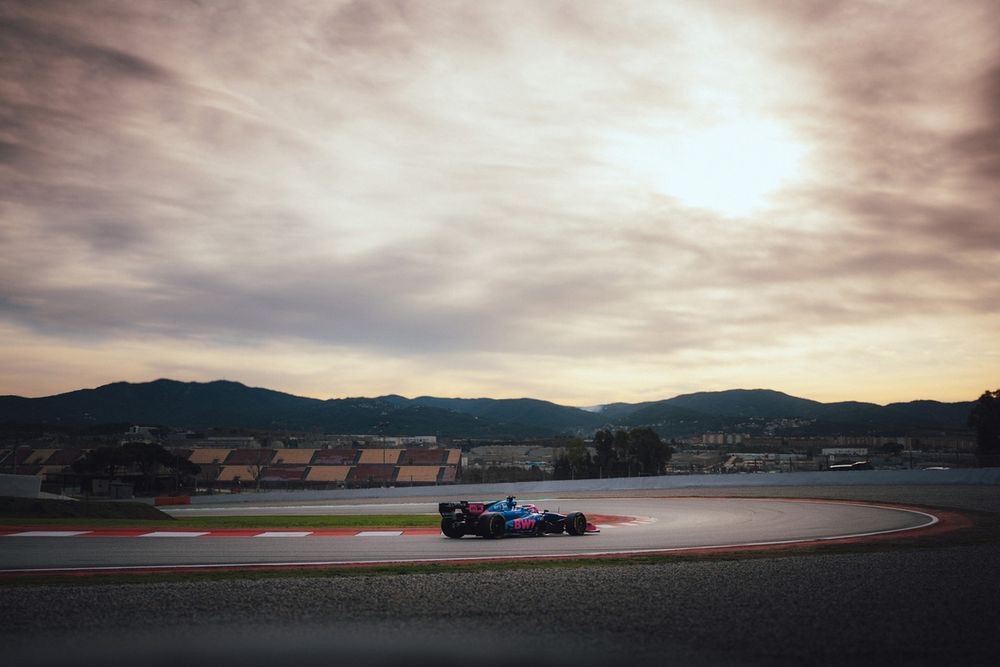
Each team observed what the competition was doing in Barcelona.
The Importance of Data Collected on Track
The data collected during races continuously feeds the simulators. Houldey detailed: “There are many things to put back into the simulator. We can improve realism because the drivers have now driven the real thing.” However, he remains cautious: “We try to do what we can in the simulator, but nothing beats being on the circuit and working with Mercedes-Benz to find the best solution.”
The performance of competitors is also closely examined. Steve Nielsen, managing director of Alpine, explained: “We look at the times, obviously, trying to deduce the fuel amounts of everyone. We only know our own. We speculate about the others and try to convince ourselves that we are performing well!”
He concludes with a note of humour: “But with the advancement of testing, especially at the end of the first and second test in Bahrain, we will see long runs from everyone, and that’s where we will make precise calculations.”
In summary, in a sport where every detail counts, technology and observation become indispensable allies for Formula 1 teams. Between simulations and stolen photos, the battle for performance is fought both in the shadows and on the track.


