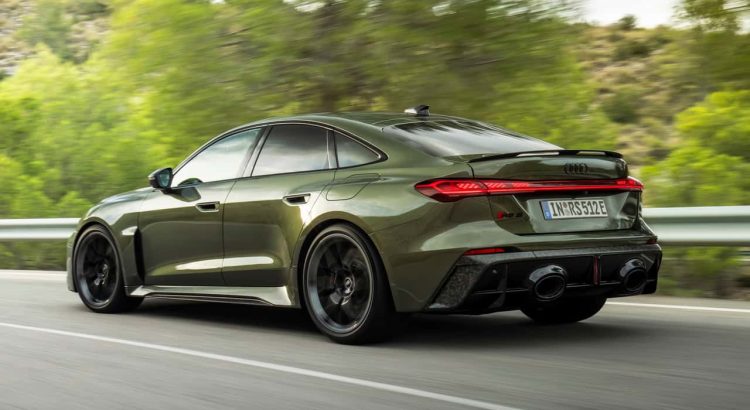
As the automotive industry trends toward downsizing, Audi stands firm with its new RS5. By sticking with its 2.9-litre twin-turbo V6, the German automaker not only asserts its sporty identity but also reinforces its industrial strategy amid increasingly fierce competition.

A Clear Choice: The V6 as a Performance Symbol
The unveiling of the new Audi RS5 confirmed what enthusiasts were hoping for: the 2.9-litre twin-turbo V6 is back. Unlike other brands, such as Mercedes-Benz, which have opted for smaller engines in some of their sporty models, Audi never considered replacing its V6 with a four-cylinder. Rolf Michl, managing director of Audi Sport, stated that there wasn’t even a discussion on the matter. This strategic choice reflects a commitment to maintaining an image of power and performance, values intrinsic to the brand.
The Hybrid Option: A Bet Not Taken
At the start of the RS5’s development, Audi considered a non-plug-in hybrid version, but this option was quickly abandoned. According to Steffen Bamberger, head of research and development, the weight increase associated with the hybrid system would have been too high to justify the performance gains. Indeed, a HEV system can weigh up to 150 kg for a range of about 10 km, a prospect deemed unattractive for customers. In short, Audi prefers to focus on raw power rather than technical compromises.
Breath-Taking Performance
The RS5, with its twin-turbo V6, delivers 463 kW and 824 Nm of torque. This translates to impressive performance: a 0 to 60 mph time of just 3.6 seconds. However, the new model also weighs in at 5,220 lbs, which is 1,376 lbs more than its predecessor. This weight increase raises questions about driving pleasure and handling. Still, Audi’s performance DNA seems to remain intact.
Competition: A Bold Positioning
In a market where most manufacturers are looking to reduce their carbon footprint and adapt to regulatory demands, Audi is taking a different path. By maintaining a V6 engine in its RS5, the automaker clearly positions itself as a defender of high-performance internal combustion engines. This choice may appeal to purists but could also isolate it from emerging market trends favouring electrification.
An Uncertain Future for Internal Combustion Engines
With the rise of electric vehicles and increasing regulatory pressures, Audi’s strategy may seem risky. However, the automaker appears determined to defend its sporting heritage. If the RS5 is a last hurrah for internal combustion engines in this category, it remains to be seen whether this strategy will pay off in the long run. Relying on a V6 engine could become a liability in a rapidly changing market.
In Summary
- Audi maintains its twin-turbo V6 for the new RS5, a strong strategic choice.
- The hybrid option was abandoned in favour of raw performance.
- The RS5 boasts impressive performance despite a significant weight increase.
- Audi’s positioning against competitors is bold but risky.
- The future of internal combustion engines in the sector remains uncertain.
In conclusion, the new Audi RS5 is a manifesto of the automaker’s philosophy: prioritising performance over hybridisation that might seem more in line with current expectations. Who is this car for? It’s for car enthusiasts seeking an authentic driving experience who aren’t afraid to stray from current trends. Alternatives abound in the market, but few offer this combination of power and identity. The RS5’s strengths are undeniable, but its strategy could cost it dearly against a competition that is rapidly evolving toward more sustainable solutions.